

A smart contract audit and a blockchain penetration test are frequently sold as the same thing, and they are not. An audit reviews contract code against known vulnerability classes. A penetration test attempts to break a running system, which includes the contracts but also the node infrastructure in front of them, the bridges and oracles they depend on, the wallets users sign with, and the ordinary web application everything sits behind. Historically the largest losses in this sector have come from bridges and oracles rather than from contract logic, which is precisely the territory a contract-only engagement never touches.
What Is Blockchain Pentesting?
Blockchain pentesting is authorized security testing of a blockchain system across every layer an attacker can reach, not just the smart contract. Most teams commission a contract audit, call it a pentest, and leave the majority of their attack surface untested.
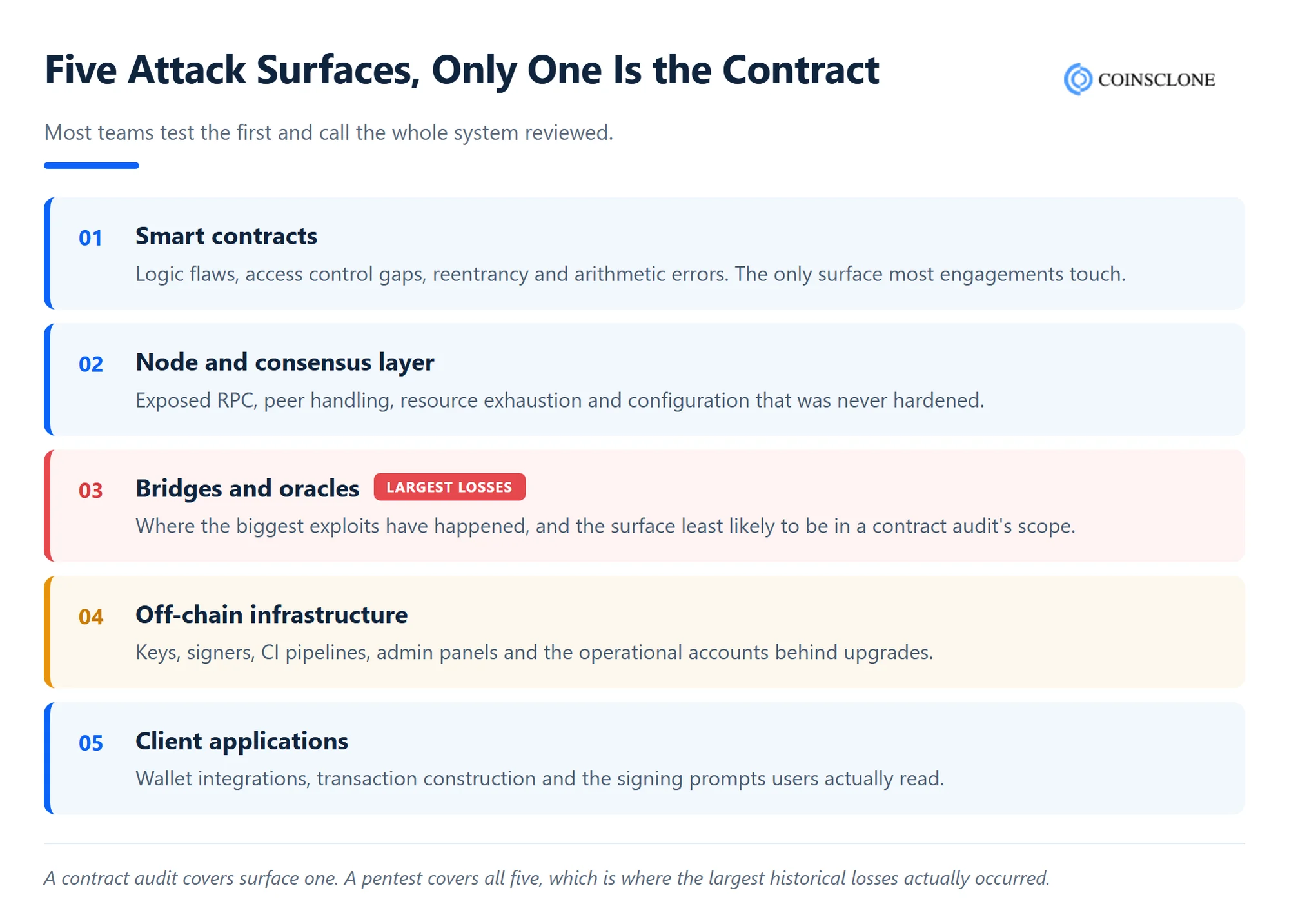
Five surfaces carry real risk, and the contract is only one:
- Smart contracts. Logic flaws, access control gaps, reentrancy and arithmetic errors.
- Node and consensus layer. RPC exposure, peer handling, resource exhaustion and configuration.
- Bridges and oracles. Where most of the largest losses have actually occurred.
- Off-chain infrastructure. Keys, signers, CI pipelines, admin panels and the operational accounts behind upgrades.
- Client applications. Wallet integrations, transaction construction and the signing prompts users actually read.
A contract audit covers the first. A pentest covers all five. The sections below set out a methodology, the attack classes that exist only on-chain, and how to scope an engagement so the result is worth what you pay for it.
Testing of this kind must be authorized in writing by the system owner and confined to the agreed scope. Everything described here assumes that authorization exists.
What Are the Attack Surfaces in a Blockchain System?
Smart contracts. Logic flaws, access control gaps, reentrancy, arithmetic errors and upgrade safety.
Node and RPC infrastructure. Exposed endpoints, unauthenticated administrative methods, missing rate limits and resource exhaustion, which are conventional infrastructure problems that happen to sit in front of a chain.
Bridges and oracles. Cross-chain message validation and price feed manipulation. This category has historically accounted for a disproportionate share of the largest losses.
Wallets and key management. Seed handling, signing flows, transaction simulation and the risk created when users blind-sign transactions they cannot interpret.
Application and API layer. The ordinary web attack surface that still sits in front of everything, and which is often the easiest route in.
An engagement scoped only to contracts leaves four of five surfaces untested, which is worth checking before comparing quotes.
Blockchain Pentest vs Smart Contract Audit
The two are complementary, and conflating them is how systems ship with a clean report and an open door.
- A smart contract audit is a deep code review of a defined contract set, usually before deployment, looking for logic and implementation flaws.
- A blockchain pentest is an adversarial exercise against the running system, including the infrastructure, the operational processes and the human controls around it.
An audit asks whether the code does what it should. A pentest asks whether an attacker can achieve a goal, using whatever path is cheapest, which is frequently a leaked deployer key or an exposed admin endpoint rather than a subtle contract flaw.
Commission both. Audit before deployment and after any significant contract change, and pentest the whole system before launch and periodically afterward, because infrastructure drifts in a way that deployed bytecode does not.
What Does a Blockchain Pentest Methodology Look Like?
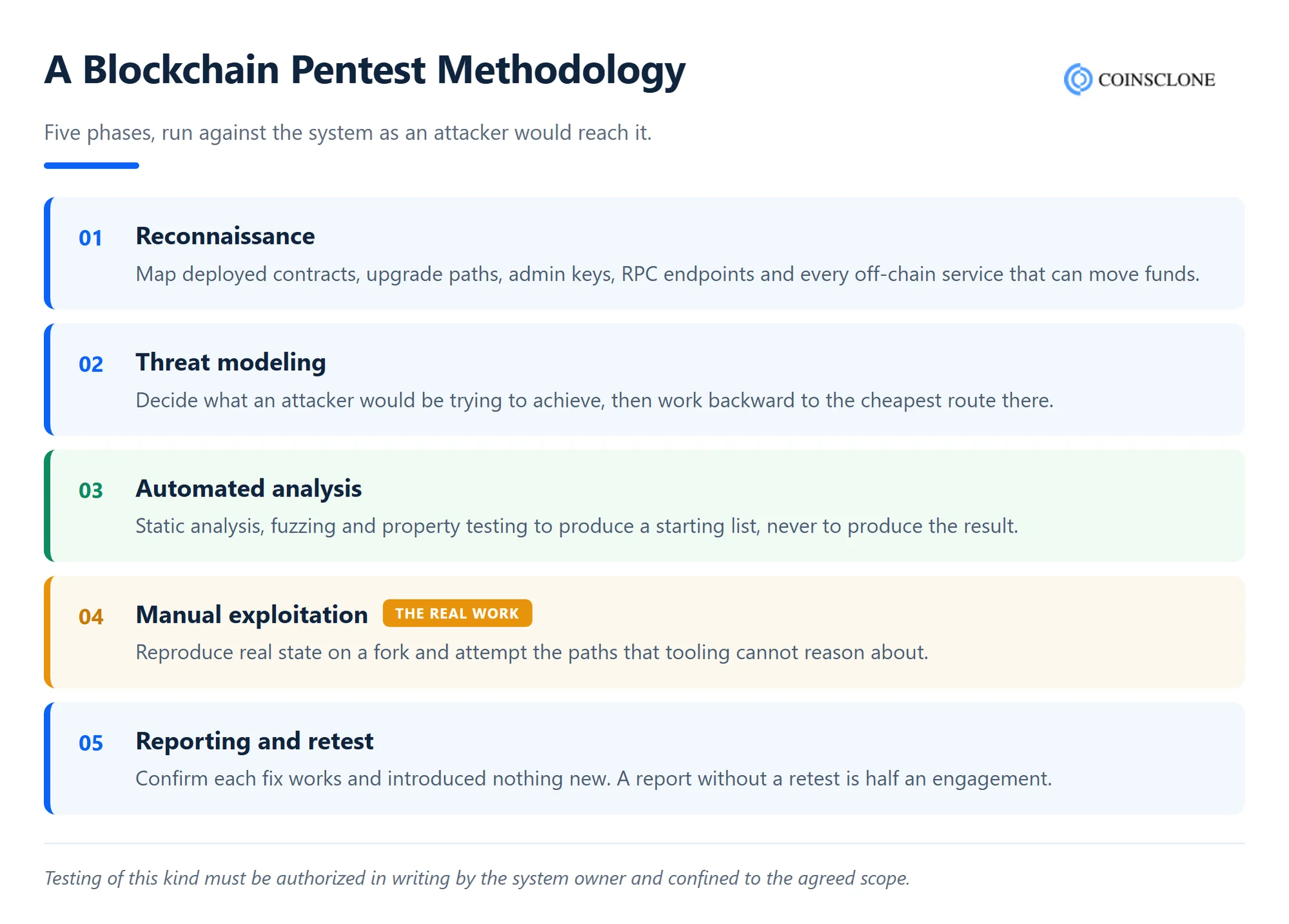
Reconnaissance. Map contracts, deployer addresses, admin keys, dependencies and exposed endpoints. This phase is unusually productive on-chain because deployment history, ownership and transaction patterns are all public. Assume an attacker has already done it.
Threat modeling. Establish who benefits from breaking the system and how much capital they could bring, since economic attacks scale with available capital rather than with skill alone.
Static and dynamic analysis. Tooling passes over the code, followed by exploitation attempts against a forked copy of mainnet state with real balances and real integrated protocols.
Economic attacks. Flash-borrowed capital, oracle manipulation and transaction ordering, which cannot be assessed by reading code alone.
Report and retest. Findings with working proofs of concept, then verification that fixes actually close them.
The forked-mainnet requirement is what distinguishes a real engagement. Testing against a local chain with fabricated balances misses whole categories of attack.
Which Tools Are Used for Blockchain Pentesting?
Tooling supports the work but does not constitute it. The categories that matter:
- Static analysis. Slither and Mythril surface common contract issues quickly and are worth running in CI, not just before an engagement.
- Fuzzing and property testing. Echidna and Foundry’s fuzzing let you assert invariants and hunt for inputs that break them, which is where the interesting findings usually come from.
- Symbolic execution. Manticore and similar tools explore paths exhaustively on constrained scopes.
- Local forking. Foundry and Hardhat forked mainnet let you reproduce real state and test exploit paths against it safely.
- Infrastructure testing. Conventional tooling still applies to RPC endpoints, key management, CI and admin surfaces, because that is conventional infrastructure.
Every tool here produces false positives and misses whole categories of logic flaw. Treat output as a starting list for manual review rather than as a result.
Which Attacks Exist Only On-Chain?
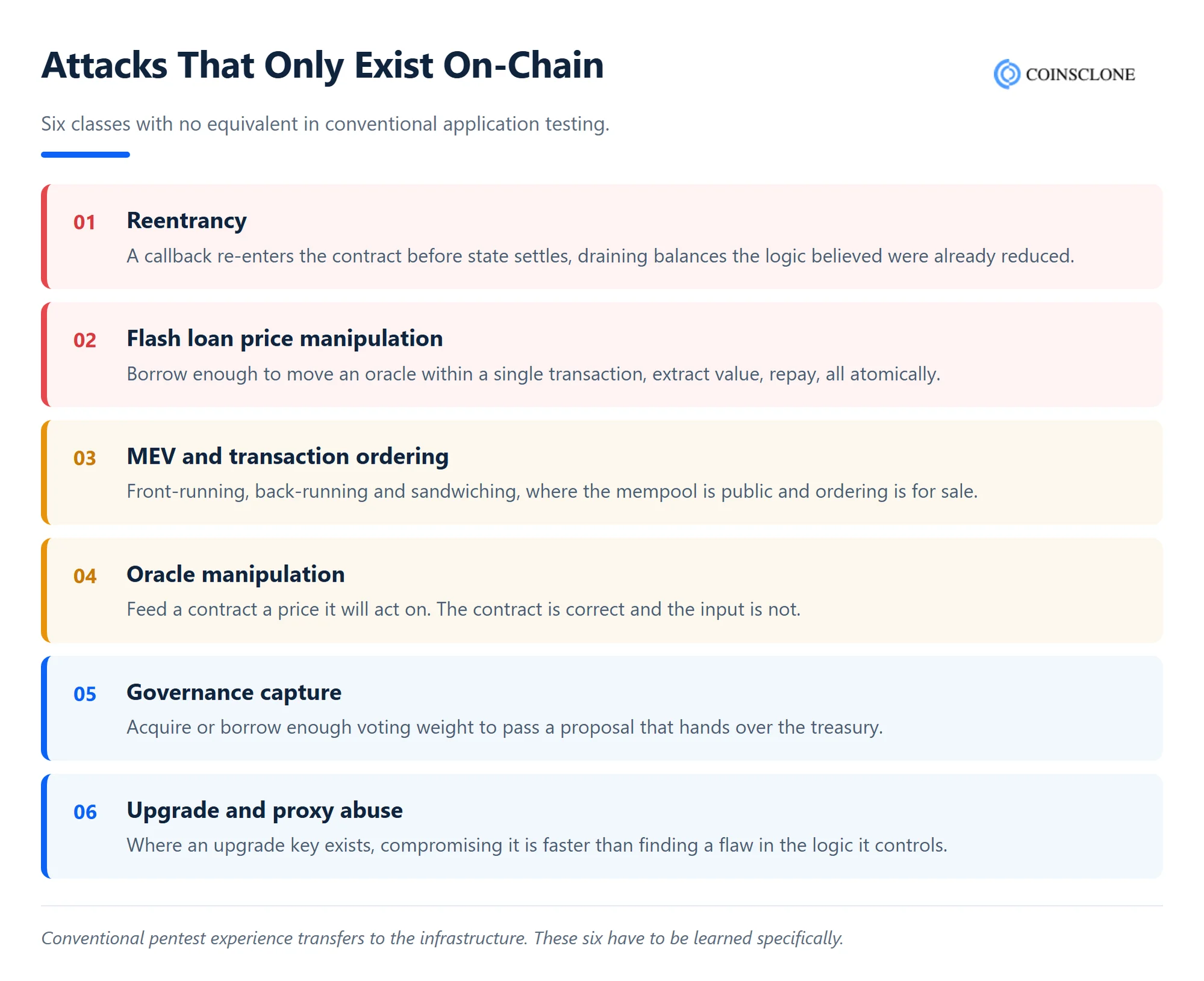
Flash loan attacks, borrowing enormous uncollateralised capital within a single transaction to move a market and exploit price-dependent logic.
Oracle manipulation, moving a price feed to trigger favorable liquidation, minting or redemption behavior.
MEV and sandwiching, where whoever builds the block reorders transactions or surrounds a victim transaction to extract value.
Governance capture, acquiring or temporarily borrowing voting power to pass a malicious proposal, which turns a governance mechanism into an attack vector.
Bridge message forgery, convincing a destination chain that a deposit occurred on the source chain when it did not.
Signature replay, reusing a valid signature in a different context, chain or contract than intended.
None of these have conventional application security equivalents, which is why a general penetration testing firm without blockchain specialism will produce a clean report on a system that is economically exploitable.
How Do You Scope a Blockchain Pentest Properly?
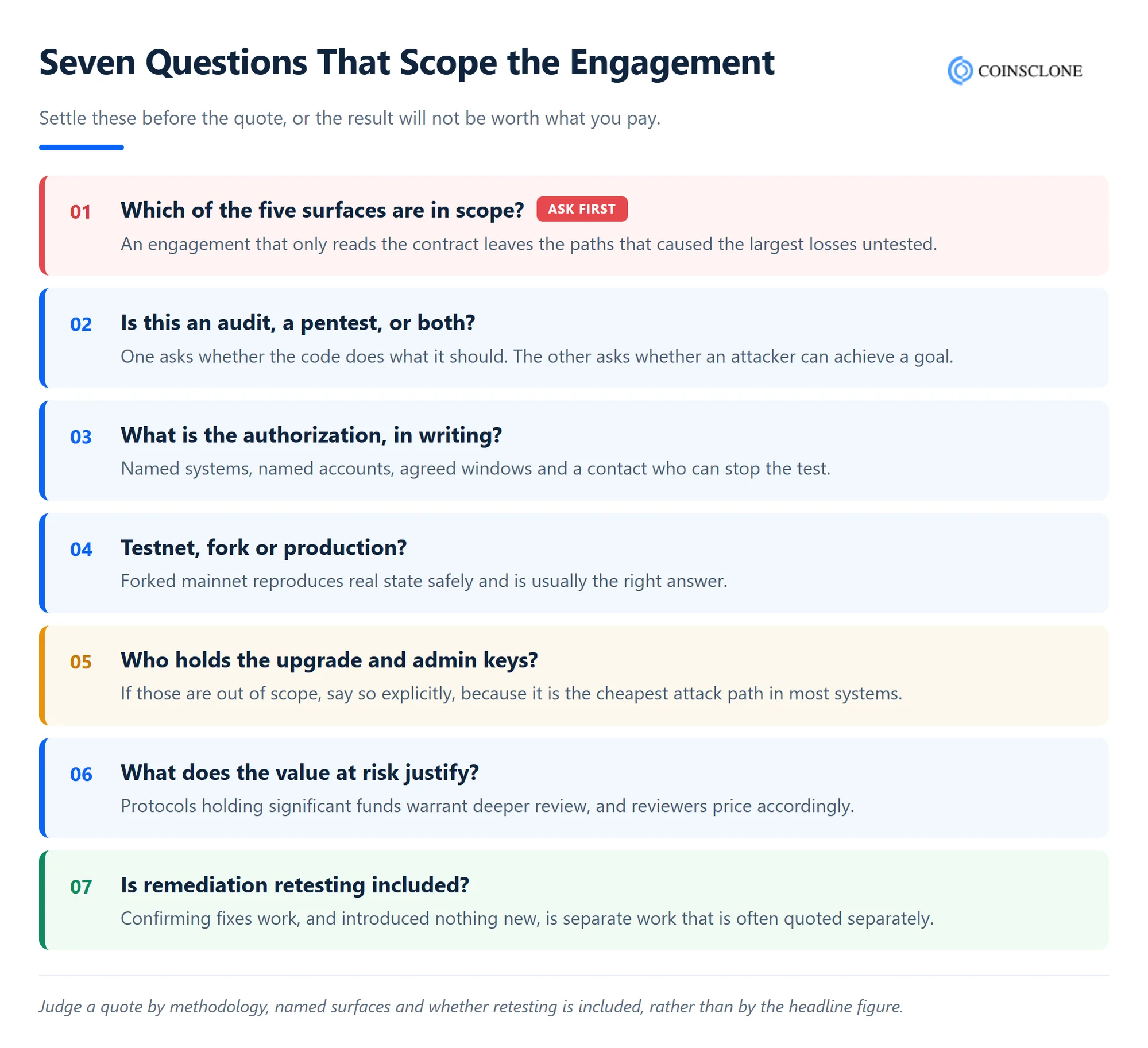
Seven questions to settle before work begins. Which contracts, chains and environments are in scope? Is testing conducted against a mainnet fork, a testnet or production? Are node and RPC infrastructure included, or contracts only? Are bridges, oracles and third-party dependencies in scope? Is economic attack simulation included, or only code review? What is the disclosure process if something critical is found mid-engagement? And is a retest after remediation included in the price?
Question five is the one that separates a genuine blockchain penetration test from a code review with a different invoice. Economic attack simulation requires forked state, capital modeling and protocol-specific knowledge, and it is where the expensive findings usually appear.
How Much Does a Blockchain Pentest Cost?
Pricing varies with scope, code size and the depth of review, and firms quote rather than publish rate cards. Confirm current figures directly, because the market moves quickly.
What drives the number:
- Scope breadth. Testing five surfaces costs more than reviewing one contract, and it is the difference between a pentest and an audit.
- Code volume and novelty. Familiar patterns review faster than a custom consensus mechanism or a new bridge design.
- Value at risk. Protocols holding significant funds warrant deeper review, and reviewers price accordingly.
- Remediation and retest. Confirming that fixes work, and that they did not introduce new issues, is separate work.
Judge a quote by the methodology, the named surfaces and whether retesting is included, rather than by the headline figure. A cheap engagement that only reads the contract leaves the paths that have historically caused the largest losses completely untested.
Conclusion
Blockchain penetration testing is worth buying when it covers what a contract audit does not: the infrastructure in front of the chain, the dependencies the contracts trust, the wallets users sign with, and the economic attacks that only become visible against real state with real capital. Scope it across all five surfaces, insist on forked mainnet testing, confirm that economic attack simulation is included, and require a retest. An engagement that omits any of those is worth less than its price suggests.
Coinsclone builds enterprise-grade Web3 platforms including crypto exchanges, wallets, DEXs, NFT marketplaces, payment gateways and RWA tokenization, using customizable white-label clone scripts. Talk to our blockchain experts for a free consultation and live demo.
Frequently Asked Questions
What is blockchain penetration testing?
A security assessment that attempts to break a running blockchain system across five surfaces: smart contracts, node and RPC infrastructure, bridges and oracles, wallets and key management, and the conventional application layer. It goes beyond code review by simulating economic attacks against realistic state.
How is pentesting different from a smart contract audit?
An audit reviews contract code against known vulnerability classes at a point in time. A penetration test attempts active exploitation of a running system including infrastructure, dependencies and economic attack vectors. Both are valuable, and a system holding significant value generally needs both.
What attacks are unique to blockchain systems?
Flash loan attacks using uncollateralised capital within one transaction, oracle manipulation to trigger favorable contract behavior, MEV and transaction sandwiching, governance capture through acquired or borrowed voting power, bridge message forgery, and signature replay across contexts or chains.
Why do bridges and oracles matter so much?
Because they are trust dependencies your contracts rely on but do not control. Historically they have accounted for a disproportionate share of the largest losses in the sector, and a penetration test scoped only to your own contracts will not examine them at all.
Should testing be done on mainnet or a fork?
Against a fork of mainnet state in almost all cases. A fork provides real balances, real liquidity and real deployed protocols, which is necessary to assess economic attacks. Testing on a local chain with fabricated state misses entire categories of vulnerability.
What should a pentest report contain?
Findings with working proofs of concept rather than theoretical descriptions, severity ratings tied to realistic exploitation cost, remediation guidance specific to your code, and a retest verifying that fixes actually close the issues rather than moving them.
How often should we pentest?
Before any major release, after significant architecture or dependency changes, and periodically thereafter. Integrated protocols, oracles and bridges change independently of your code, so a system tested a year ago sits in a different environment today even if nothing in your repository changed.