

Intellectual property runs through five stages, and blockchain is genuinely useful at two of them, marginal at two more, and entirely absent from one. Being precise about which is which matters more here than in most technology discussions, because creators who believe a timestamp has registered their rights discover otherwise at the worst possible moment. This guide walks the lifecycle from creation through registration, licensing and monitoring to enforcement, states plainly where a ledger contributes, and sets out how to build an evidence workflow that a lawyer can actually use.
What Are the Main Blockchain Use Cases in Intellectual Property?
Blockchain does three useful things for intellectual property, and none of them is registering your rights. It timestamps that a work existed in a given form at a given moment, it records a chain of assignments and licenses that nobody can quietly rewrite, and it gives you an evidence trail you can hand to a lawyer without asking anyone to trust your word.
The use cases that survive contact with a real dispute cluster around those three jobs:
- Proof of creation. A hash of the work, anchored on-chain, fixing the date it existed.
- Chain of title. Assignments, licenses and transfers recorded in order and in public.
- Licence administration. Terms and royalty splits executed by contract rather than by invoice.
- Evidence for enforcement. A tamper-evident record of infringement, capture date and provenance.
- Supply chain authentication. Proving a physical item is the one the rights holder made.
- Collective rights management. Splitting income between contributors by verifiable share.
What follows walks the IP lifecycle stage by stage, names the six enforcement scenarios where this actually helps, and is blunt about the one stage it cannot touch.
Where Blockchain Fits in the IP Lifecycle
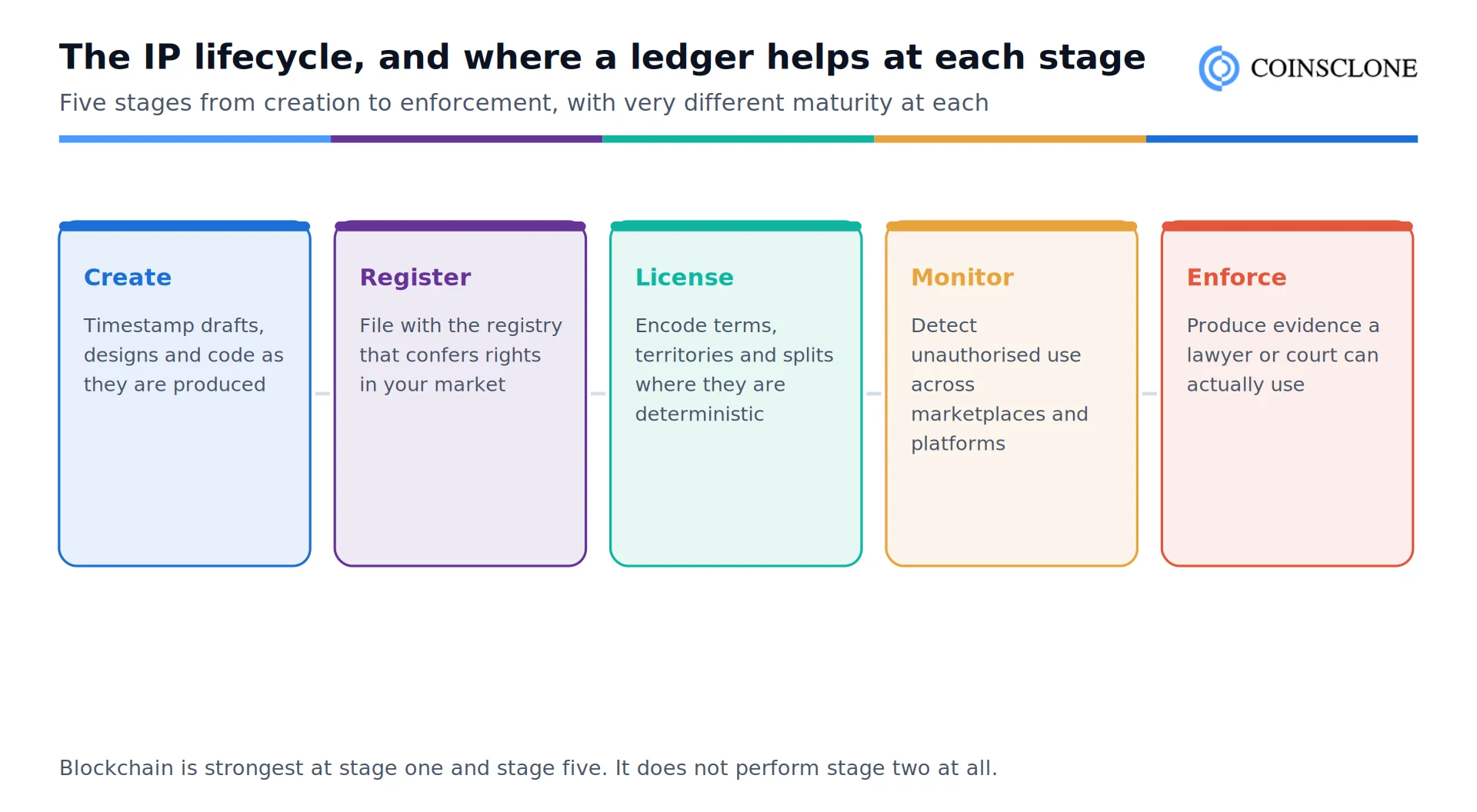
Create. Timestamp drafts, designs, source code and research records as they are produced. This is where blockchain is strongest and cheapest.
Register. File with the registry that confers rights in your market. Blockchain does not perform this stage at all and cannot substitute for it.
License. Encode terms, territories and splits where they are deterministic. Partially useful, and limited by how much of a real license reduces to code.
Monitor. Detect unauthorised use across marketplaces and platforms. Mostly a data and search problem rather than a ledger one.
Enforce. Produce evidence a lawyer or court can actually use. This is the second stage where a ledger earns its cost.
The pattern is worth internalising: blockchain is an evidence technology in this context, not a rights technology.
Which Industries Use Blockchain for IP?
The pattern is consistent: blockchain earns its place where the work is created fast, copied easily, and disputed often enough that the cost of proving authorship matters.
- Music and audio. Split sheets with dozens of contributors, where the argument is usually about percentages rather than authorship, and royalty administration is the expensive part.
- Photography and stock imagery. High volume, trivially copied, and individually low value, which makes conventional registration uneconomic per image.
- Design and fashion. Short product cycles where a design is copied before any registration completes.
- Film and television. Long contributor chains and complex licensing windows across territories.
- Pharmaceutical and industrial R&D. Laboratory notebooks and invention disclosures, where the date of conception can decide a priority dispute.
- Software and open source. Contribution provenance and license compliance across many authors.
In every one of these the value is the same. It is cheaper to prove something than to argue about it.
Why Blockchain Does Not Replace Registration
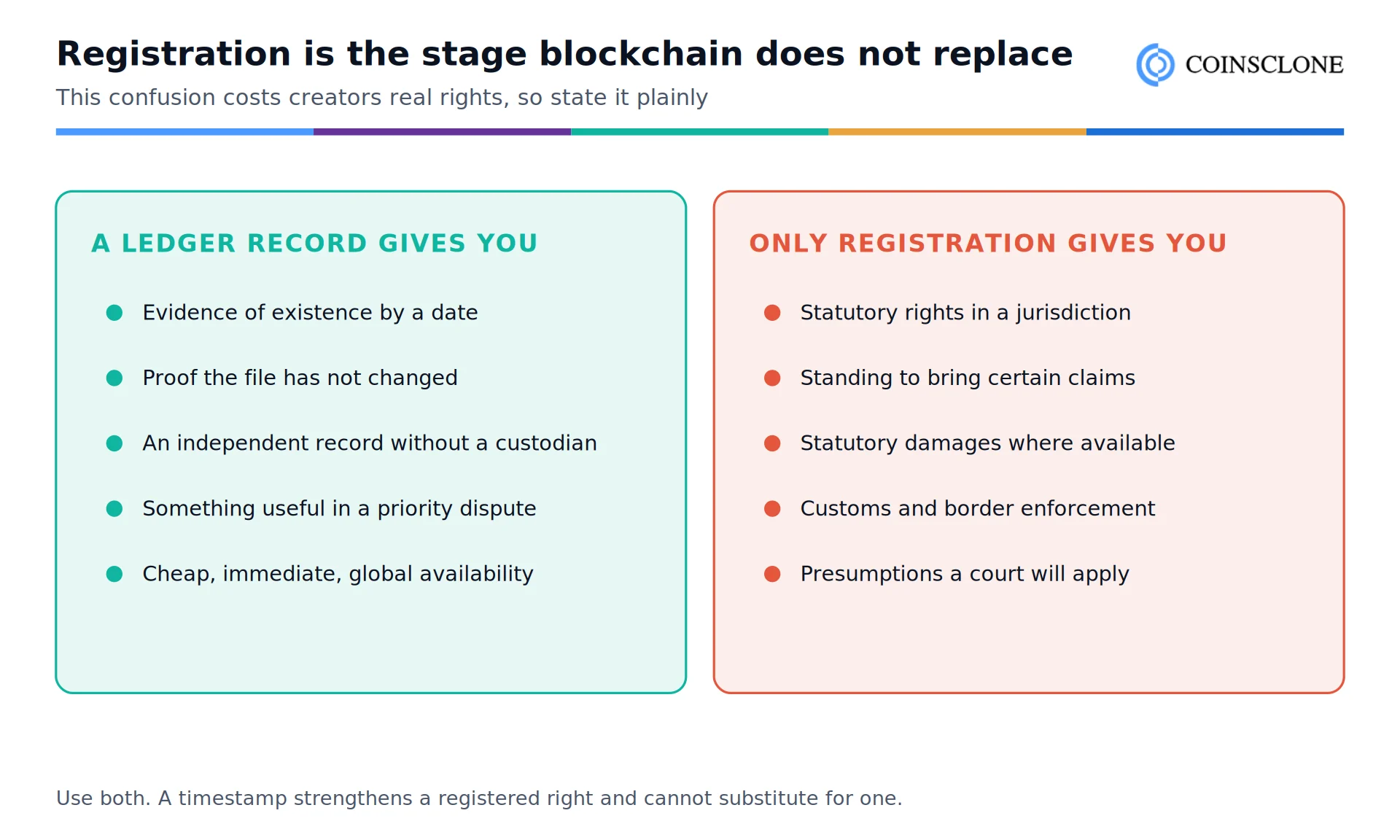
A ledger record gives you evidence of existence by a date, proof the file has not changed, an independent record without relying on a custodian, something useful in a priority dispute, and global availability at negligible cost.
Only registration gives you statutory rights in a jurisdiction, standing to bring certain claims, statutory damages where available, customs and border enforcement, and the legal presumptions a court will apply.
These are different categories of thing. A timestamp strengthens a registered right considerably and substitutes for it not at all. The correct approach is both: register where registration confers rights, and timestamp continuously alongside it so that the material leading up to a filing is also evidenced.
Six Enforcement Scenarios Where It Actually Helps
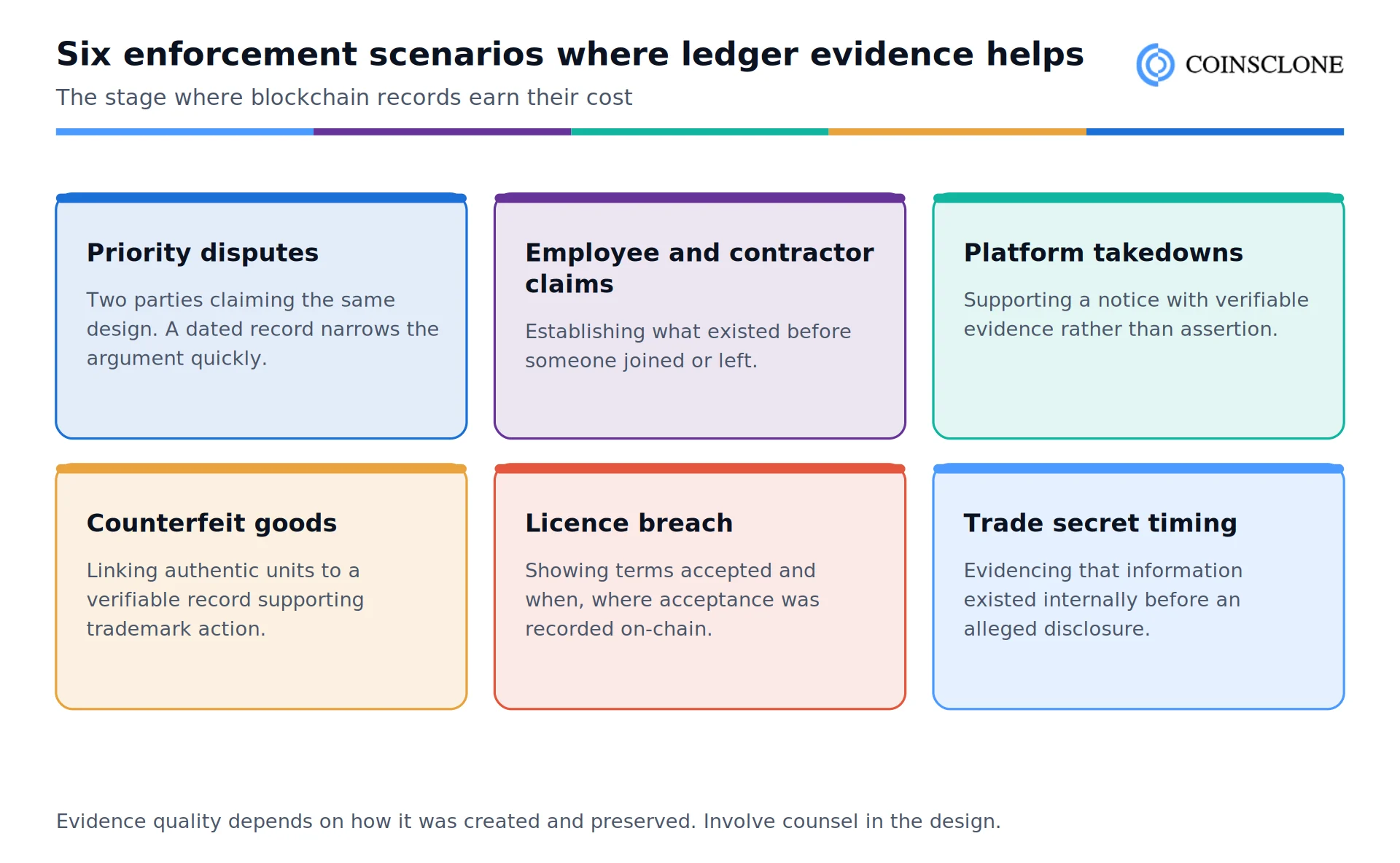
Priority disputes, where two parties claim the same design and a dated record narrows the argument quickly.
Employee and contractor claims, establishing what existed before someone joined or after they left.
Platform takedowns, supporting a notice with verifiable evidence rather than assertion, which materially improves response quality.
Counterfeit goods, linking authentic units to a verifiable record that supports trademark action.
Licence breach, showing which terms were accepted and when, where acceptance was recorded on-chain.
Trade secret timing, evidencing that information existed internally before an alleged disclosure.
In each case the ledger does not decide anything. It removes an argument about facts so the dispute can proceed on substance.
How Do You Build an Evidence Workflow That Holds Up?
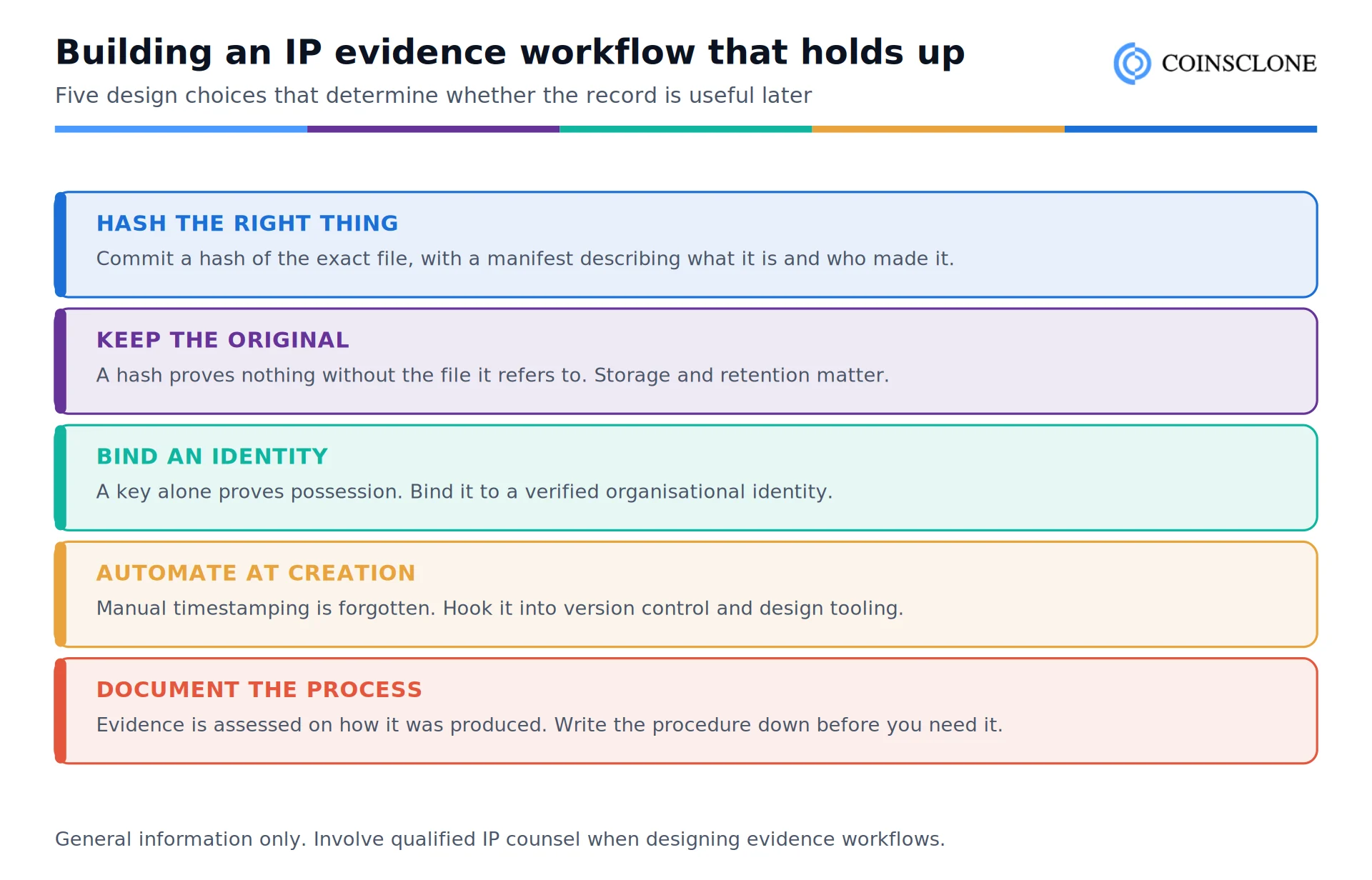
Hash the right thing. Commit a hash of the exact file alongside a manifest describing what it is, who produced it and in what context. A bare hash with no manifest is weak evidence.
Keep the original. A hash proves nothing without the file it refers to, so storage, retention and retrieval matter as much as the commitment.
Bind an identity. A key alone proves possession of a key. Bind it to a verified organisational identity so the record points at a person or company.
Automate at creation. Manual timestamping is forgotten within weeks. Hook it into version control, design tooling and document management so it happens without anyone deciding to.
Document the process. Evidence is assessed partly on how it was produced. Write the procedure down before you need to rely on it.
This is general information rather than legal advice. Involve qualified IP counsel when designing an evidence workflow you intend to rely on.
Using Blockchain Evidence in a Real Dispute
An anchored hash is worthless if nobody can explain what it proves. Making it useful in a dispute takes a workflow, not just a transaction.
- Capture the work in a fixed form and generate a cryptographic hash of that exact file. Any later edit produces a different hash, which is the point.
- Anchor the hash on a public chain and keep the transaction reference. The work itself never goes on-chain, both for confidentiality and because personal data on a public ledger cannot be removed.
- Record the surrounding facts off-chain: who created it, when, on what system, and under what agreement.
- Preserve the original file under an unbroken custody record. The hash proves the file has not changed. It does not produce the file.
- Document the method so a third party can repeat the verification without your help.
Step five is the one teams skip and the one that decides whether the evidence is persuasive. A verification anyone can reproduce is worth far more than an assertion from the rights holder.
What Blockchain Cannot Do for Intellectual Property
Being clear about the limits is what makes the rest of the argument credible.
- It does not register anything. Patents, trade marks and registered designs are granted by offices, and an on-chain record has no standing with any of them.
- It does not prove you are the author. It proves a file existed at a time. If someone else made it and you hashed it, the chain records your timestamp on their work.
- It does not establish originality or novelty. Those are legal tests applied to the content, not to the record.
- It does not enforce anything by itself. Enforcement is still a takedown, a letter or a court, and the chain only supplies evidence for them.
- Admissibility varies by jurisdiction. Courts increasingly accept cryptographic evidence, but the weight given to it depends on local rules and on how well you documented the method.
None of this is legal advice. Anchor the evidence, then take it to counsel in the jurisdiction that matters.
Conclusion
Blockchain earns a permanent place in IP practice as an evidence layer: cheap, continuous, independent proof of what existed when. It does not register rights, does not decide ownership and does not enforce anything by itself. Used alongside proper registration and with a documented, automated workflow, it removes factual arguments from disputes. Presented as a substitute for filing, it creates confidence that fails precisely when it is tested.
Coinsclone builds enterprise-grade Web3 platforms including crypto exchanges, wallets, DEXs, NFT marketplaces, payment gateways and RWA tokenization, using customizable white-label clone scripts. Talk to our blockchain experts for a free consultation and live demo.
Frequently Asked Questions
Can blockchain replace IP registration?
No. Registration with the relevant national or regional office is what confers statutory rights, standing and remedies. A blockchain record provides evidence that content existed by a date and has not been altered, which strengthens a position but creates no rights on its own.
How does blockchain help with IP enforcement?
By removing factual arguments. Dated, tamper-evident records support priority disputes, employee and contractor claims, platform takedown notices, counterfeit actions, license breach claims and trade secret timing questions, allowing a dispute to proceed on substance rather than on whose account of dates is correct.
What should be committed to the ledger?
A hash of the exact file plus a manifest describing what it is, who produced it and in what context. Keep the original file in retrievable storage, since a hash without the underlying file proves nothing.
Will a court accept blockchain evidence?
Treatment varies by jurisdiction and depends heavily on how the evidence was created and preserved. It is generally treated as corroborating evidence rather than conclusive proof, and a documented, automated process strengthens its weight considerably. Seek qualified advice where the position matters.
Can smart contracts handle IP licensing?
Partially. Terms that reduce to deterministic rules can be encoded and enforced at point of use. Conditions requiring judgement, territory-specific interpretation or negotiation do not translate, and off-chain usage is invisible to a contract, which limits automated enforcement.
Does this work for patents as well as copyright?
Indirectly. Tamper-evident laboratory and research records can support inventorship and priority claims, and timestamping can evidence when conception occurred. It does not replace filing, examination or the jurisdictional patent system in any respect.
How do we start?
Automate timestamping at the point of creation by hooking it into version control and design tooling, keep originals in retrievable storage, bind commitments to a verified organisational identity, and document the procedure. Then continue registering rights exactly as you do now.