
Identity verification is four separate questions that get collapsed into one word, and the two that cause most real-world fraud are the two that cryptography does not answer. A signature check proves a credential is genuine and unaltered. It says nothing about whether the person holding the phone is the person the credential describes. This article separates those checks, walks through how a verifiable credential exchange actually works, explains why selective disclosure is the strongest argument for this approach, and covers where these systems fail in production.
How Does Blockchain Identity Verification Work?
Blockchain identity verification checks a signed credential the user already holds, instead of collecting their documents again and storing them. The verifier confirms who issued the credential, that it has not been tampered with, that it has not been revoked, and that the person presenting it is the person it was issued to. The ledger is consulted for issuer keys and revocation status. It never holds the document.
The flow, in the order it happens:
- An authority issues a signed credential to the subject’s wallet.
- The subject presents a proof of that credential to a relying party.
- The relying party checks the issuer’s key and the credential’s signature.
- The relying party checks the revocation registry.
- The relying party confirms the presenter controls the subject’s identifier.
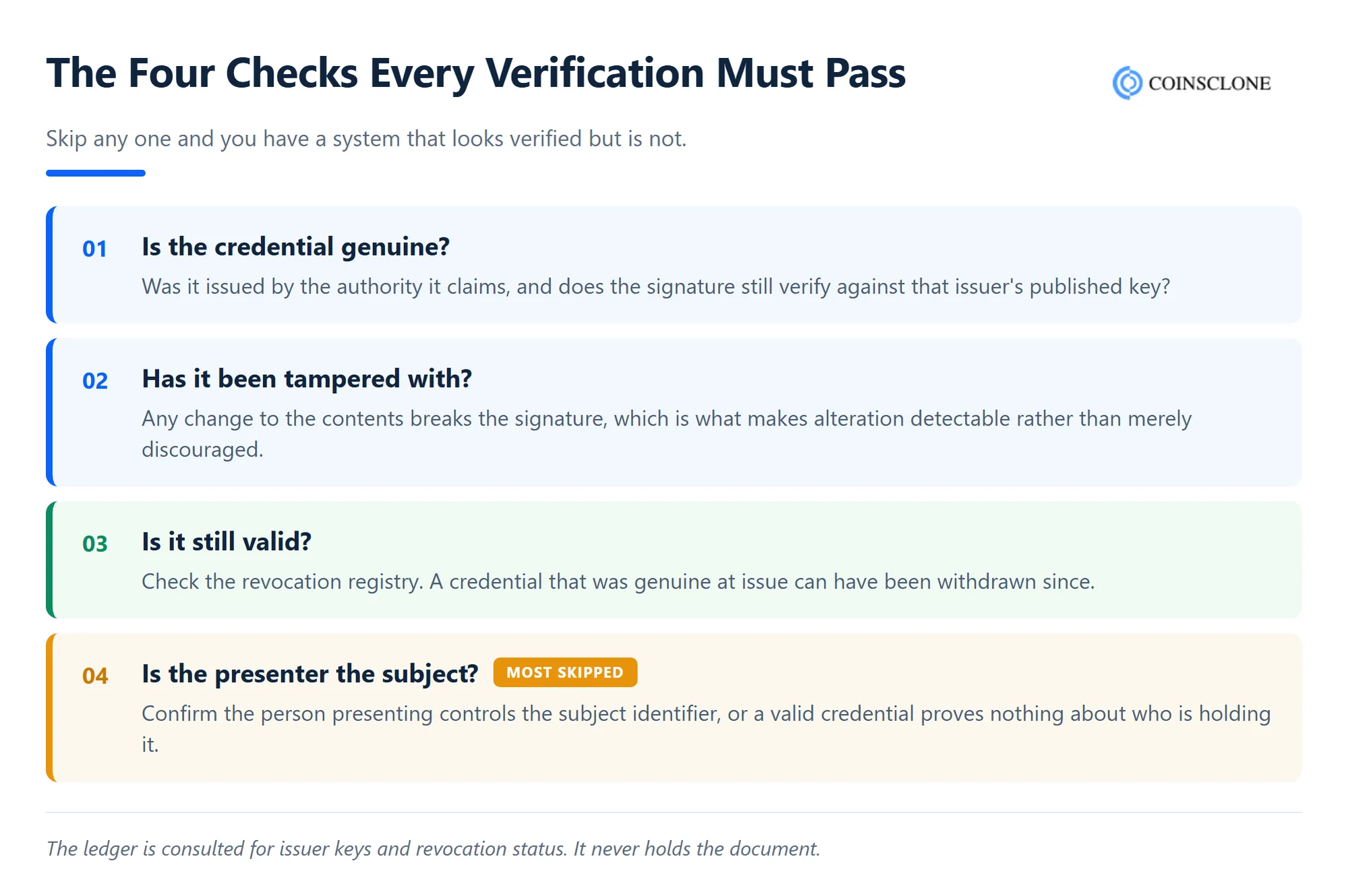
Each of those four checks answers a different question, and skipping any one of them produces a system that looks verified but is not. The sections below walk through them, then cover selective disclosure, where these systems fail, and how the model compares with conventional KYC.
The Four Checks Every Verification Must Pass
Is the credential genuine? Was it issued by the party it claims, and has it been altered since. Answered by signature and hash verification.
Is it still valid? Has it expired or been revoked since issuance. This requires a live status check against a revocation mechanism, and it is routinely skipped.
Is this person the holder? Binding the credential to the human presenting it, usually through biometric or device-based binding established at enrolment.
Is the holder actually present? Liveness detection, defeating photographs, screen replays and increasingly synthetic video.
Only the first two are cryptographic problems with clean solutions. The third and fourth are where the overwhelming majority of real fraud occurs, and no amount of ledger design improves them.
How Does a Verification Exchange Work Step by Step?
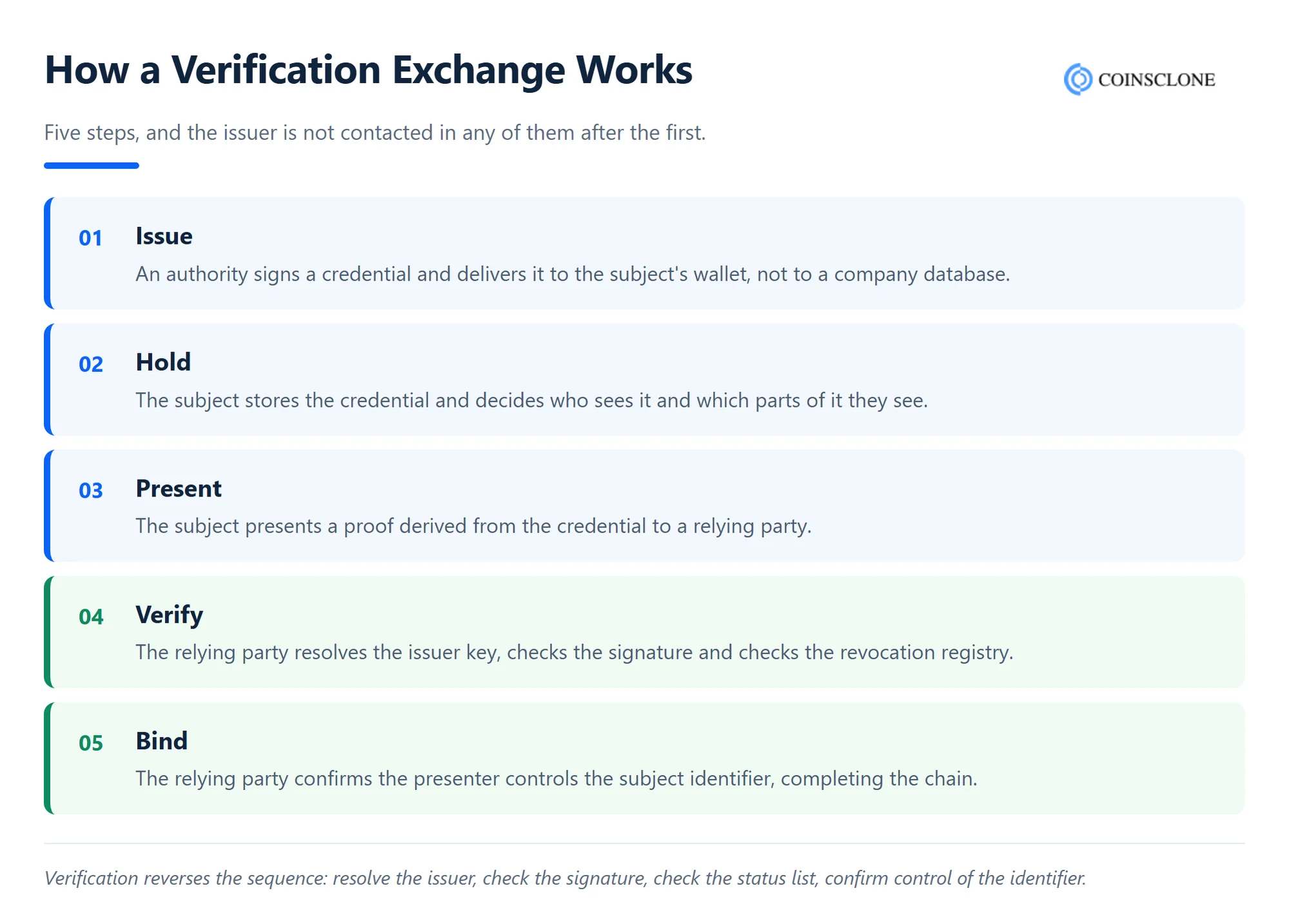
Issue. An authority signs a credential asserting claims about a subject and delivers it to the holder.
Hold. The holder stores it in a wallet they control, rather than the issuer retaining it and answering queries about it.
Present. The holder shares a proof with a verifier, disclosing only what is required.
Check. The verifier validates the signature against the issuer’s published key, checks revocation status, and confirms holder binding.
Decide. Access is granted or refused, and the check is logged for audit.
Notice that the verifier never contacts the issuer. That is what allows verification to work at scale, to continue functioning if the issuer is closed or defunct, and to avoid the issuer learning where their credentials are being used. The credential itself is never on the ledger. Only issuer keys, schemas and revocation status live there.
Blockchain Identity Verification vs Traditional KYC
Conventional KYC repeats the same work at every relying party. Each one collects documents, runs the same checks, and then stores the results, which multiplies both the cost and the number of places a breach can happen.
The reusable model changes the economics rather than the checks themselves.
- Who does the work. Traditional KYC verifies from scratch per relying party. Reusable credentials verify once at the issuer and check cheaply thereafter.
- What gets stored. Traditional KYC leaves document copies with every party. Credential checks leave a verification result and no documents.
- How long it takes. Document collection and review takes minutes to days. Checking a signature and a revocation entry takes under a second.
- What breaches expose. A traditional provider holds a document archive. A credential verifier holds almost nothing worth stealing.
- Regulatory acceptance. This is the honest weak point. Reliance rules vary by jurisdiction, and in many the relying party keeps the obligation even when it trusts another party’s check.
The technology is ready in more places than the regulation is, so confirm the reliance position in every market you operate in before designing around it.
What Is Selective Disclosure and Why Does It Matter?
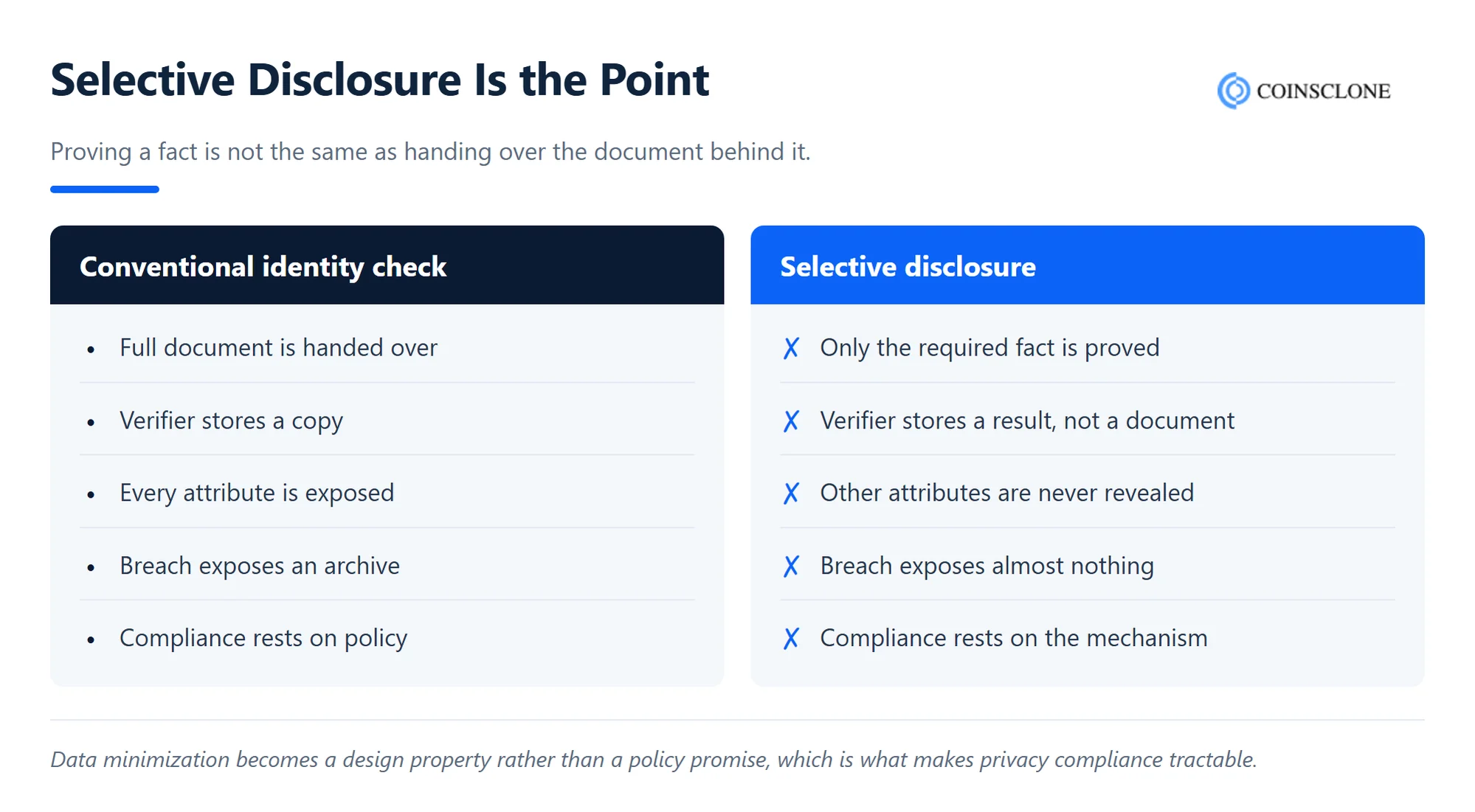
A conventional identity check involves handing over a full document. The verifier sees your name, address and document number, then stores a copy. Every check creates another copy, and breach exposure grows with each one.
Selective disclosure inverts this. You prove a single attribute, such as being over eighteen, without revealing your date of birth. The verifier stores a proof rather than a document. No new copy of the underlying data is created, and breach exposure stays bounded regardless of how many times you verify.
This is the strongest argument for verifiable credentials, and it is worth noticing that it is a privacy argument rather than a blockchain argument. The ledger supports it by publishing issuer keys and revocation status in a way no single party controls, but the privacy benefit comes from the credential model itself.
Where Is Blockchain Identity Verification Actually Used?
Reusable verification pays off wherever the same person is checked repeatedly by different parties.
- Financial onboarding. A customer verified once at one regulated institution can open an account at another without resubmitting documents, where reliance rules permit it.
- Age and eligibility checks. Selective disclosure proves someone is over a threshold without revealing a birth date, which is exactly what most age gates actually need.
- Professional licensing. A regulator issues a credential that any employer or client can check instantly, replacing letters and phone calls.
- Cross-border employment. Right-to-work and qualification credentials verify without bilateral integrations between national systems.
- Healthcare access. Proving entitlement or professional registration without exposing the record behind it.
The common thread is repetition. Where verification happens once in a lifetime, the reusable model adds cost without returning much.
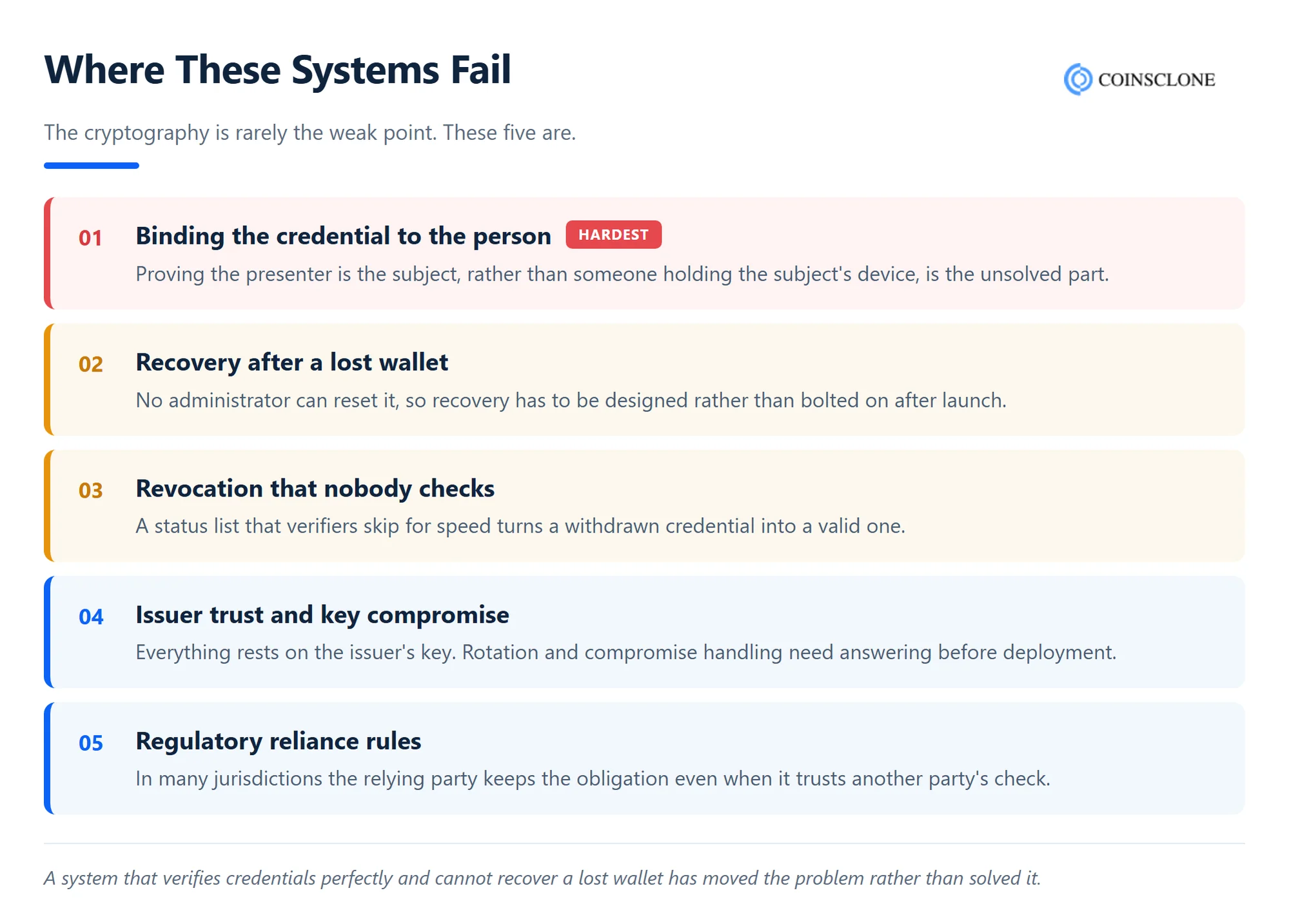
Where Blockchain Identity Verification Systems Fail
Weak initial binding. If enrolment is sloppy, a perfectly verified credential belongs to the wrong person forever. Enrolment quality caps everything downstream.
Revocation not checked. Verifiers that skip the status check accept credentials that were withdrawn, which defeats the mechanism entirely.
Recovery undefined. A lost device becomes a lost identity unless recovery was designed in advance, and recovery mechanisms are themselves an attack surface.
Verifier adoption. A credential nobody accepts has no value regardless of its technical quality, and this is a commercial problem rather than an engineering one.
Deepfake-capable attacks. Liveness detection has become an arms race rather than a solved problem, and any system treating it as solved will be defeated.
None of these are cryptographic failures. All of them are why deployments underperform.
Conclusion
Blockchain identity verification works well for the two questions cryptography answers cleanly: is this credential genuine, and is it still valid. It contributes nothing directly to the two questions that matter most in fraud terms, which are whether the presenter is the rightful holder and whether they are actually present. Build with that division clear, invest heavily in enrolment quality, insist that verifiers actually check revocation, and treat selective disclosure as the reason to adopt the model at all.
Coinsclone builds enterprise-grade Web3 platforms including crypto exchanges, wallets, DEXs, NFT marketplaces, payment gateways and RWA tokenization, using customizable white-label clone scripts. Talk to our blockchain experts for a free consultation and live demo.
Frequently Asked Questions
How does blockchain identity verification work?
An issuer signs a credential and gives it to the holder, who stores it in their own wallet. When verification is needed the holder presents a proof, and the verifier checks the signature against the issuer’s published key, checks revocation status, and confirms the credential is bound to the presenter. The verifier never contacts the issuer.
Is personal data stored on the blockchain?
No, and it should never be. The ledger holds issuer public keys, credential schemas and revocation status. The credential itself and any personal attributes remain with the holder, because an append-only ledger cannot support correction or erasure of personal data.
What is selective disclosure?
Proving a specific attribute without revealing the underlying data, such as demonstrating you are over eighteen without disclosing your date of birth. The verifier stores a proof rather than a copy of your document, which limits how much personal data accumulates across checks.
Does blockchain prevent identity fraud?
It prevents credential forgery and undetected alteration. It does not prevent someone presenting a genuine credential that is not theirs, nor sophisticated presentation attacks against liveness detection. Enrolment quality and biometric binding carry that burden, not the ledger.
What happens if someone loses their device?
That depends entirely on whether recovery was designed in. Options include social recovery, backup credentials, or reissuance by the original issuer. Recovery is itself an attack surface, so it should be designed deliberately rather than added after the first support ticket.
Why do verifiers need to check revocation?
Because a credential valid at issuance may have been withdrawn since, whether through qualification removal, employment ending or license suspension. A verifier that checks only the signature will accept revoked credentials, which defeats the purpose of the system.
Is this different from conventional KYC?
It changes where data sits rather than removing the need for identity proofing. Initial enrolment still requires document checks and biometrics. What changes afterwards is that subsequent verifications reuse a credential the holder controls, rather than each verifier collecting and storing another copy of the same documents.