
Decentralized identity is sold as a product and is actually an architecture, which is why buyers frequently end up with components that do not interoperate. The market uses one label for at least six different things, and the layer that determines whether any of it works in practice is the least technical one. This guide sets out the four architectural layers, states precisely what belongs on a ledger and what must not, maps the vendor landscape by category, and provides the questions that matter before committing to a stack.
What Is Blockchain Identity Management?
Blockchain identity management is a way of issuing and verifying identity where the person holds their own credentials in a wallet and the ledger holds only the pointers needed to check them. No central database stores the identity documents, and no single operator can revoke access to them.
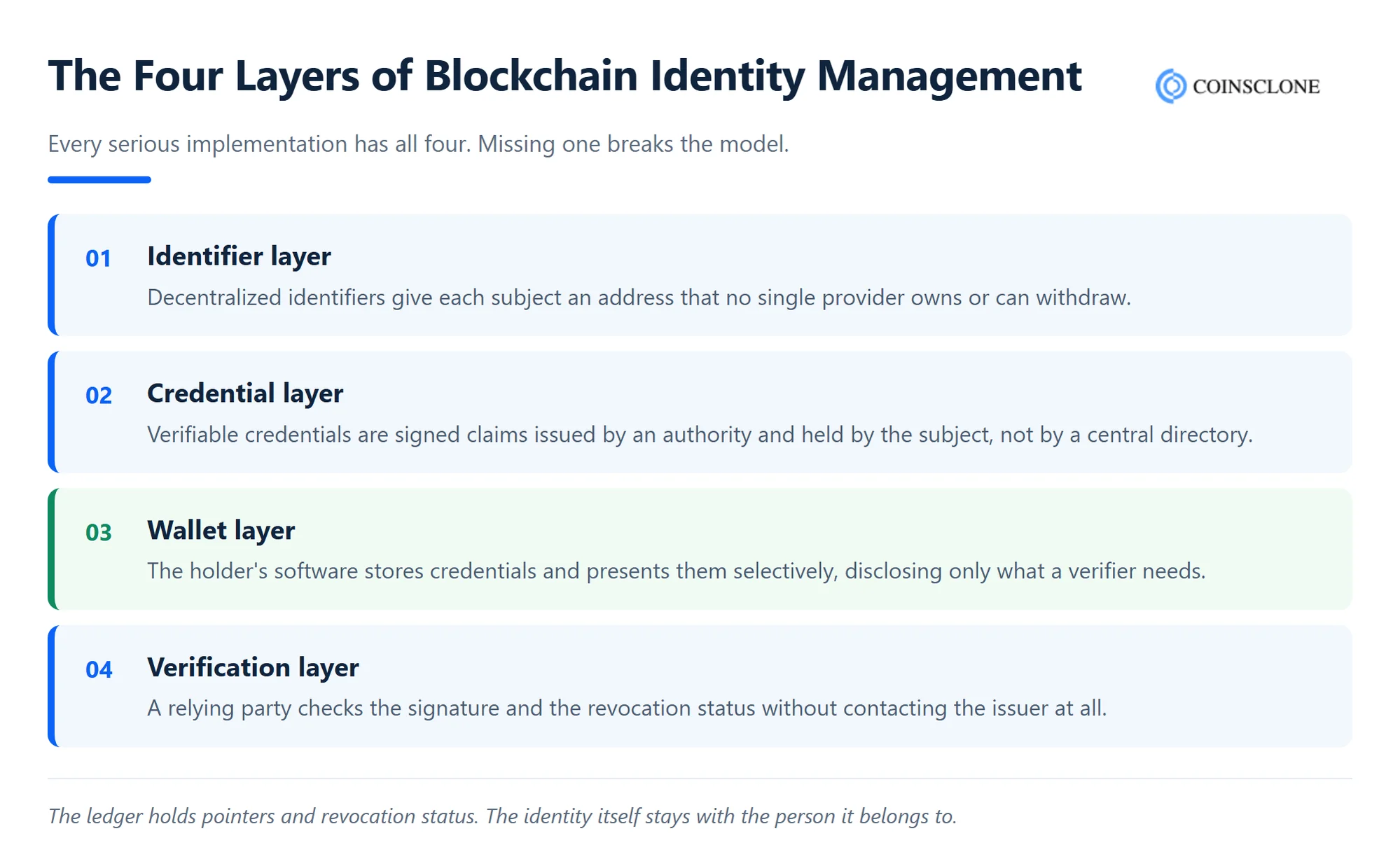
Four pieces make up every serious implementation:
- Identifiers. Decentralized identifiers, or DIDs, give each subject an address that is not owned by any one provider.
- Credentials. Verifiable credentials are signed claims issued by an authority and held by the subject.
- Wallet. The holder’s software stores credentials and presents them selectively.
- Verification. A relying party checks the signature and the revocation status without contacting the issuer.
The rest of this guide covers what belongs on the ledger, what must never go on it, the vendor categories to choose between, and the questions to ask before committing to a stack.
The Four Layers of a Blockchain Identity Management System
Identifier layer. Decentralized identifiers that resolve to public keys and service endpoints, giving every participant a stable, verifiable reference not owned by any platform.
Credential layer. Verifiable credentials, meaning signed claims with schemas, issuers, subjects and expiry.
Wallet layer. Where holders store credentials and consent to presentations, and where most of the user experience problem lives.
Trust layer. Which issuers are recognized, and by whom. A cryptographically perfect credential from an issuer nobody recognizes is worthless.
The trust layer is the hardest and the least technical. It is governance, accreditation and commercial agreement rather than engineering, and it determines whether your credentials are accepted anywhere.
How Is It Different From Traditional Identity Management?
Traditional identity management keeps the authoritative record inside one organization’s directory. That works until the organization is breached, goes away, or becomes the bottleneck for everyone who needs to verify something.
The differences that matter in practice:
- Where the data sits. Traditional systems store attributes centrally. Blockchain identity leaves attributes with the holder and stores only what is needed to verify them.
- Who can revoke. A central provider can disable an account unilaterally. A holder-controlled credential can be revoked by its issuer, but the holder keeps the credential and its history.
- Breach blast radius. A central directory is a single high-value target. Holder-held credentials distribute the risk across many wallets.
- Verification cost. Federated systems need a live call to the identity provider. Verifiable credentials check offline against a signature and a revocation registry.
- Portability. Traditional identity is bound to its issuer’s system. A verifiable credential travels with the holder across relying parties.
The trade is real: recovery becomes harder when no operator can reset a user’s access, and that problem is dealt with by social or custodial recovery rather than by ignoring it.
What Are the Benefits of Blockchain Identity Management?
The case for this architecture rests on a small number of concrete gains rather than on decentralization as a principle.
- Smaller breach surface. Data you do not hold cannot be stolen from you, which also reduces what a regulator can penalize you for losing.
- Lower verification cost. Checking a signature is cheaper and faster than integrating with each issuer’s API and maintaining those integrations.
- Cross-border portability. A credential issued in one jurisdiction can be verified in another without a bilateral integration.
- Data minimization by default. Selective disclosure lets a relying party learn that someone is over eighteen without learning their birth date, which makes privacy compliance a design property rather than a policy promise.
- Auditability without exposure. Revocation registries and issuer keys are publicly checkable while the underlying attributes stay private.
These are the gains that survive contact with procurement. Arguments that rest on decentralization alone generally do not.
What Goes on the Ledger and What Must Not
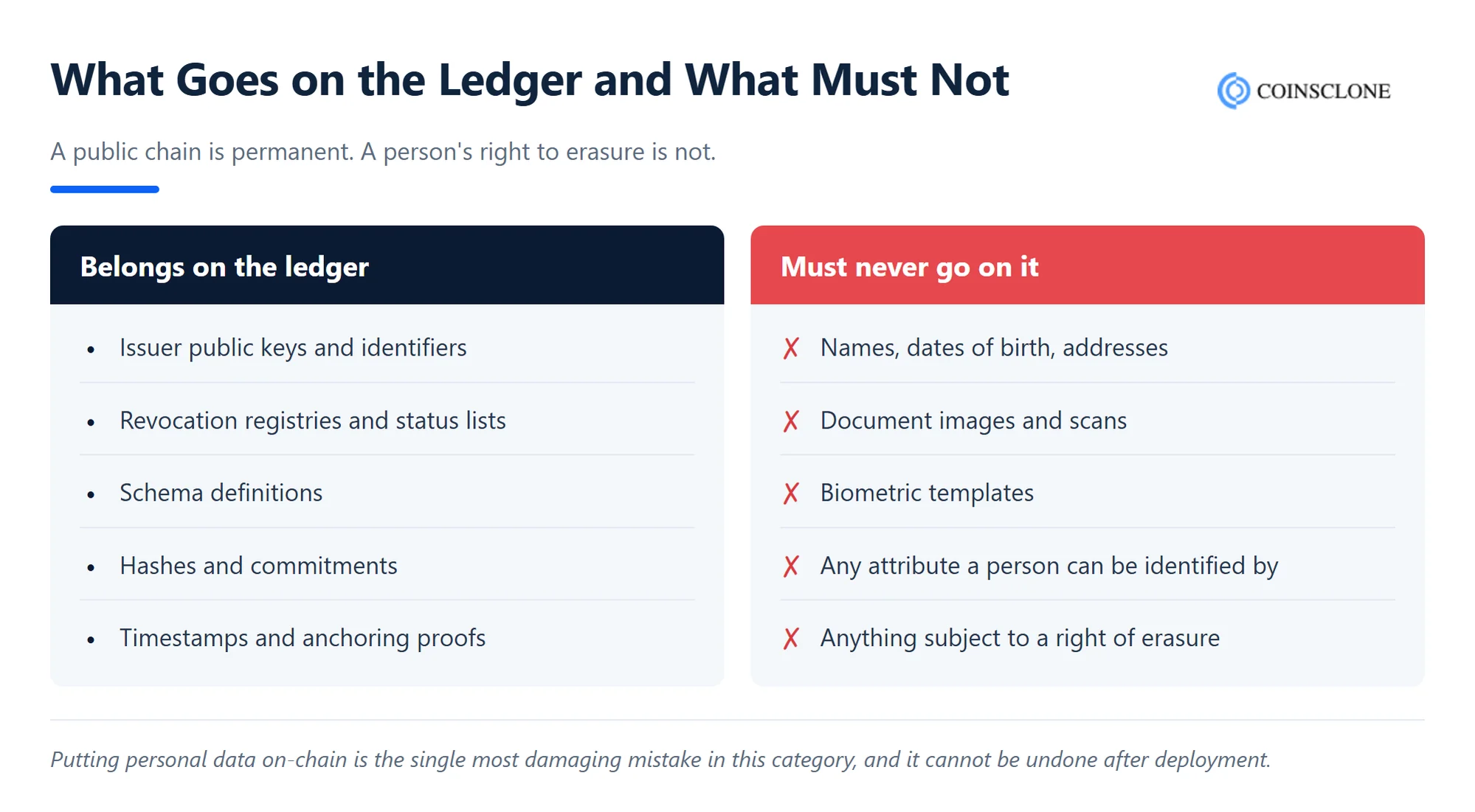
On the ledger: decentralized identifier documents, public keys and key rotation history, credential schemas and definitions, revocation registries and status lists, and issuer trust registries.
Never on the ledger: the credential itself, any personal attribute or identifier, biometric templates, presentation and usage history, and anything subject to erasure rights.
Correlation risk deserves particular attention. Even hashes of personal data can be matched if the input space is small or guessable, so hashing a national identifier and publishing it is not a privacy measure. Usage history is equally sensitive: a ledger recording every presentation creates a surveillance trail that undermines the privacy argument for adopting credentials in the first place.
Blockchain Identity Management Vendors and Platforms
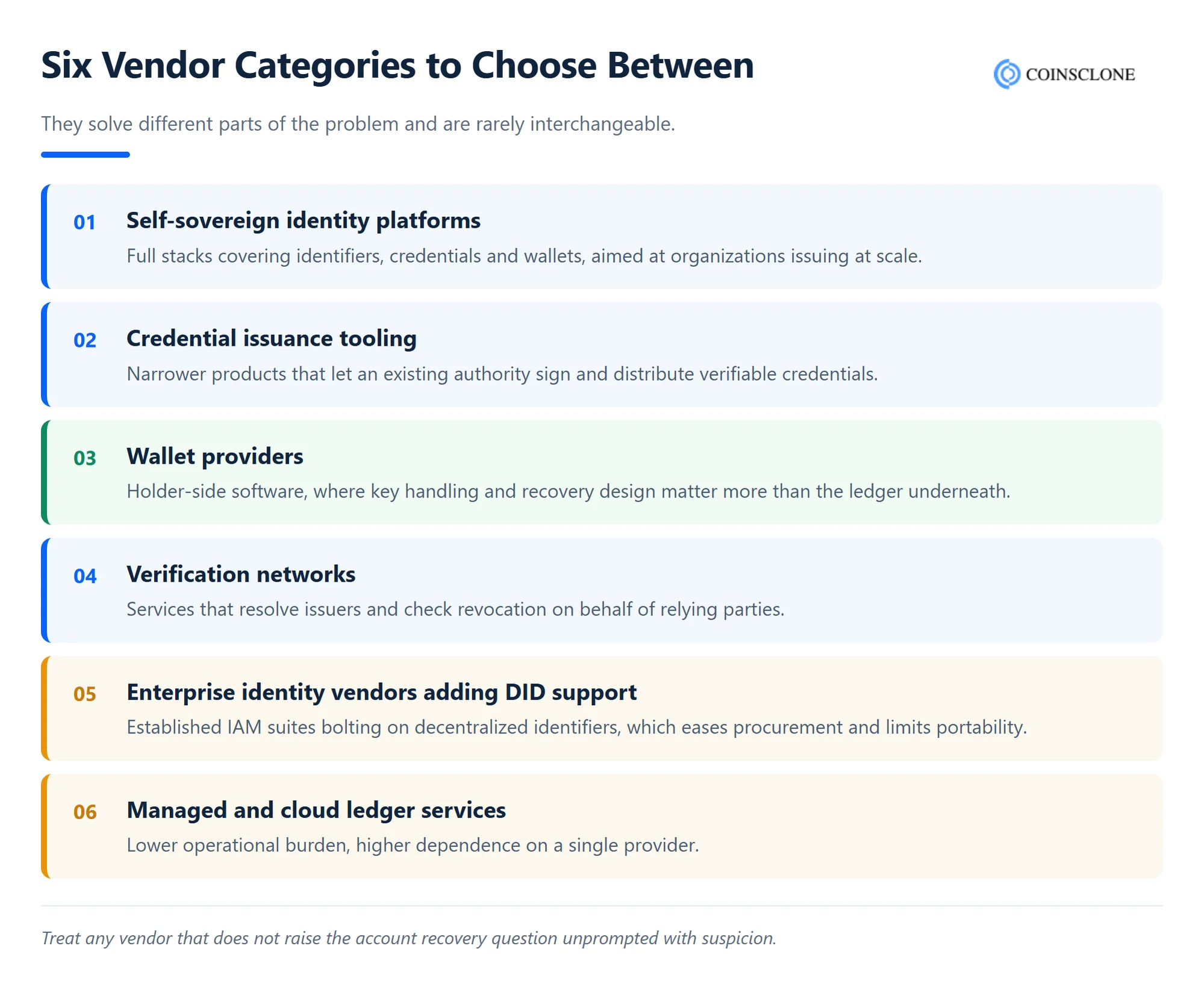
Credential platforms handle issuance, schema management and revocation infrastructure.
Wallet providers cover holder-side storage, consent and presentation experiences.
Verification services provide verifier-side checking, status resolution and audit logging.
Identity networks operate shared trust registries and governance across many participants.
KYC and onboarding vendors handle initial enrolment, document checks, biometrics and liveness.
Integration layers connect all of the above to existing identity and access management systems.
Most enterprises need three or four of these categories, and very few vendors are genuinely strong across all six despite marketing that suggests otherwise. Evaluate by category first, then assess which gaps a given vendor actually fills.
What Are the Challenges and Limitations?
The obstacles to adoption are mostly organizational rather than cryptographic, and any honest evaluation should start with them.
- Recovery. If a holder loses their wallet, there is no administrator to reset it. Social recovery, custodial backup or a hybrid model has to be designed in from the start.
- Issuer participation. The model delivers nothing until enough authorities issue credentials, and persuading them is a commercial problem, not a technical one.
- Interoperability in practice. W3C DIDs and verifiable credentials are standards, but DID methods and revocation approaches vary enough that two conforming systems may still not interoperate.
- Regulatory fit. Data protection law was written around controllers and processors, and holder-centric identity does not map onto those roles cleanly.
- Key management for ordinary users. Asking people to safeguard cryptographic keys has failed repeatedly in consumer products, which is why abstracted key handling matters more than the ledger choice.
Treat any vendor that does not raise the recovery question unprompted with suspicion.
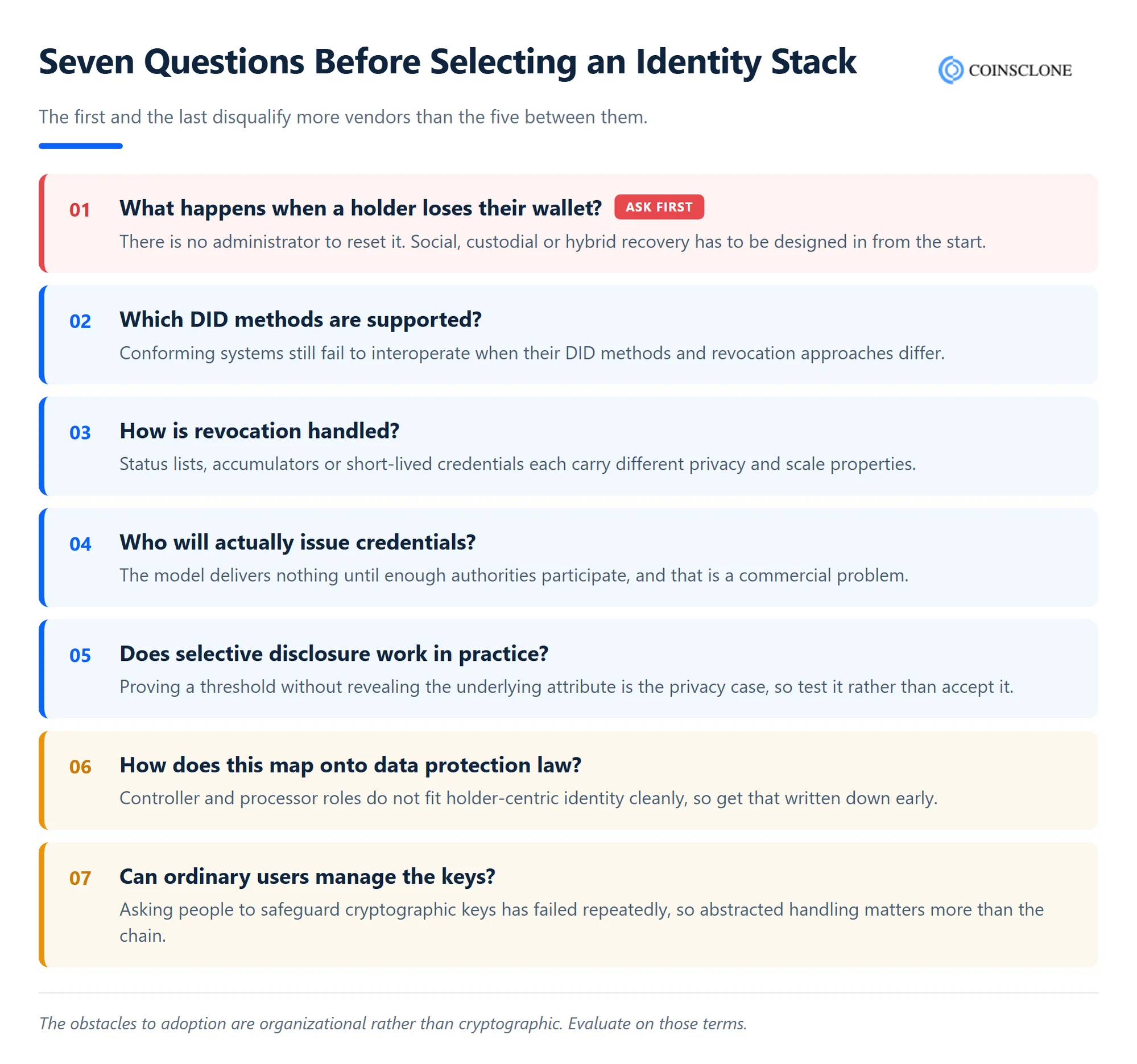
Seven Questions to Ask Before Selecting an Identity Stack
Which standards do you implement, and how strictly? Can credentials you issue be verified outside your platform? How is revocation published, and how do verifiers check it? What happens when a holder loses their device? How do you avoid correlation across presentations? What is stored on-chain, and can you justify each item? And if we leave, what do we keep and what stops working?
Question two is decisive. A credential that can only be verified inside one vendor’s platform is a database record with additional ceremony, and it forfeits the interoperability that justifies the architecture. Question seven is the one buyers most often skip and most often regret.
Conclusion
Decentralized identity works when the four layers are chosen deliberately and the trust layer is treated as a commercial problem rather than a configuration setting. Keep credentials and personal data off the ledger, confine on-chain content to identifiers, keys, schemas and revocation status, and select vendors by category against the gaps you actually have. Above all, insist that credentials you issue can be verified outside the platform that issued them, because interoperability is the entire reason to adopt this model.
Coinsclone builds enterprise-grade Web3 platforms including crypto exchanges, wallets, DEXs, NFT marketplaces, payment gateways and RWA tokenization, using customizable white-label clone scripts. Talk to our blockchain experts for a free consultation and live demo.
Frequently Asked Questions
What is blockchain identity management?
An architecture with four layers: decentralized identifiers resolving to public keys, verifiable credentials carrying signed claims, wallets where holders store and present them, and a trust layer determining which issuers are recognized. The ledger publishes keys, schemas and revocation status rather than identity data.
What is stored on the blockchain in an identity system?
Identifier documents, public keys and rotation history, credential schemas, revocation registries and issuer trust registries. Credentials, personal attributes, biometric templates and presentation history must never be stored on-chain, both for privacy and because ledgers cannot support erasure.
What is a decentralized identifier?
A stable identifier that resolves to a document containing public keys and service endpoints, controlled by the subject rather than issued and owned by a platform. It allows a credential to reference an issuer or holder without depending on any single provider remaining in business.
Which vendor category do we actually need?
Most enterprises need three or four: a credential platform for issuance and revocation, a wallet for holders, verification services for the checking side, and integration into existing identity systems. Identity networks and KYC vendors are added depending on whether you need shared trust registries or initial enrolment.
How do we avoid vendor lock-in?
By insisting that credentials issued through a platform can be verified outside it, checking standards conformance rather than accepting claims of it, and asking explicitly what you retain and what stops working if you leave. Interoperability is the reason to adopt this architecture and the first thing compromised in practice.
What is correlation risk?
The ability to link a person’s activity across different verifications. It arises when identifiers are reused across presentations, when usage history is published, or when hashed personal data can be matched by guessing the input. Designs should make repeated presentations unlinkable.
Why is the trust layer the hardest part?
Because it is governance rather than engineering. Deciding which issuers are recognized, by whom, and under what accreditation is a commercial and institutional negotiation. A technically flawless credential from an unrecognised issuer has no value to a verifier.