
Institutions spend a great deal of money answering the question “did this person really get this qualification”, and the people asking spend a great deal of time waiting for an answer. Verifiable credentials remove that exchange entirely. An issuer signs a credential once, the holder keeps it, and any verifier can check it independently without contacting anyone. That structural change is what makes the model interesting, more than any property of the underlying ledger. This article covers the three-party model, why it beats a PDF, the revocation problem that vendors skip, and where these credentials are genuinely being used.
What Are Blockchain Credentials and Verifiable Certificates?
A blockchain credential is a digital certificate that anyone can verify without contacting the body that issued it. The issuer signs the credential cryptographically, the recipient holds it, and a verifier checks the signature and the revocation status against a public registry. The certificate itself never goes on the ledger.
That distinction is the whole design. What sits on-chain is the issuer’s public key, a revocation entry, and at most a hash. The credential, with the name and the grade and the dates, stays with the person it belongs to.
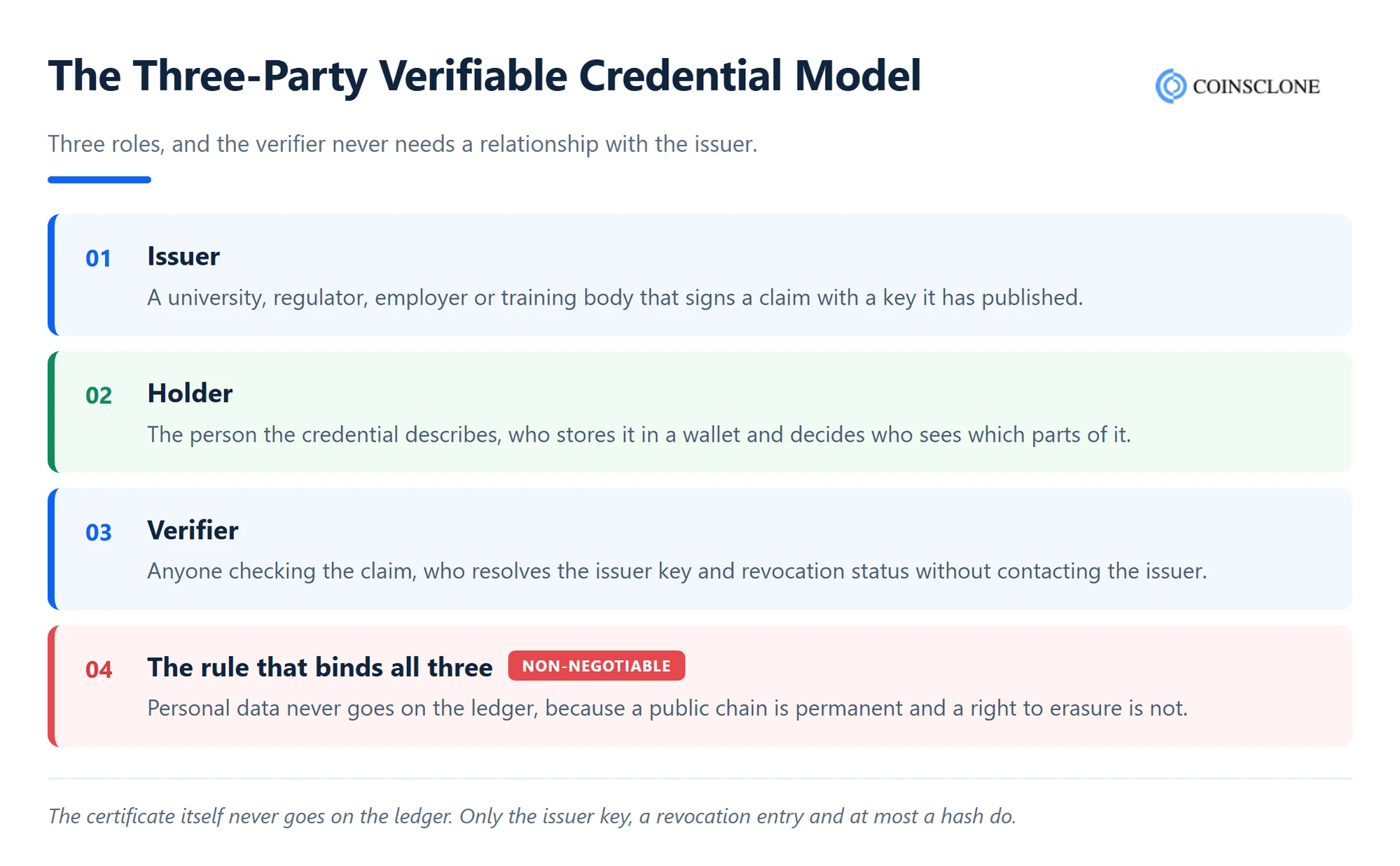
Three parties and one rule:
- Issuer. A university, regulator, employer or training body that signs the claim.
- Holder. The person the credential describes, who stores it in a wallet and decides who sees it.
- Verifier. Anyone checking it, who needs no relationship with the issuer to do so.
- The rule. Personal data never goes on the ledger, because a public chain is permanent and a person’s right to erasure is not.
The sections below cover how this beats a PDF, why revocation is the part most projects get wrong, and where verifiable certificates are already in production.
The Three-Party Model Behind Every Verifiable Credential
Issuer. Signs a credential asserting claims about a subject. A university, employer, regulator or professional body.
Holder. Stores the credential in a wallet they control and decides when and to whom to present it.
Verifier. Checks the signature against the issuer’s published key, checks revocation status, confirms holder binding, and decides.
The important structural point is that the verifier never contacts the issuer. This is what allows verification at scale, permits checking when the issuer is closed or has ceased to exist, and prevents the issuer from learning where a person is presenting their qualifications. It also removes the manual verification workload that institutions currently carry, which is the clearest commercial argument in the model.
How Are Verifiable Certificates Issued and Checked?
Issuing a verifiable certificate is a short sequence, and each step maps onto something the verifier will later check.
- Establish the issuer identity. The issuing body publishes a decentralized identifier and its public key so verifiers can resolve them independently.
- Build the claim. The credential is assembled as structured data following the W3C Verifiable Credentials model, with the subject, the claim and the validity dates.
- Sign it. The issuer signs with the private key matching the published identifier. The signature is what makes tampering detectable.
- Deliver it to the holder. The credential goes to the recipient’s wallet, not to a company database.
- Register revocability. The issuer records a revocation entry, typically a status list, so the credential can be withdrawn later without recalling anything.
Verification then reverses the sequence: resolve the issuer, check the signature, check the status list, and confirm the presenter controls the subject identifier.
Why a Verifiable Credential Beats a PDF Certificate
Forgery. A signed credential cannot be edited without invalidating the signature, unlike a document that can be altered in minutes.
Verification cost. No phone calls or emails to the issuing institution, which is where the current expense sits on both sides.
Issuer availability. Verification works even if the issuer is closed, has merged or no longer exists, which matters for qualifications held over decades.
Revocation. A withdrawn qualification or suspended license can be marked invalid and checked instantly, which paper cannot do at all.
Selective disclosure. Prove a qualification without revealing grades, dates or other attributes on the same document.
Portability. The holder carries credentials across employers, countries and platforms without requesting reissuance.
Verification cost is the strongest commercial argument. Institutions dedicate real staff time to answering verification requests, and that cost disappears entirely.
What Are the Benefits of Verifiable Certificates?
The gains over a signed PDF or a registry lookup are specific and measurable.
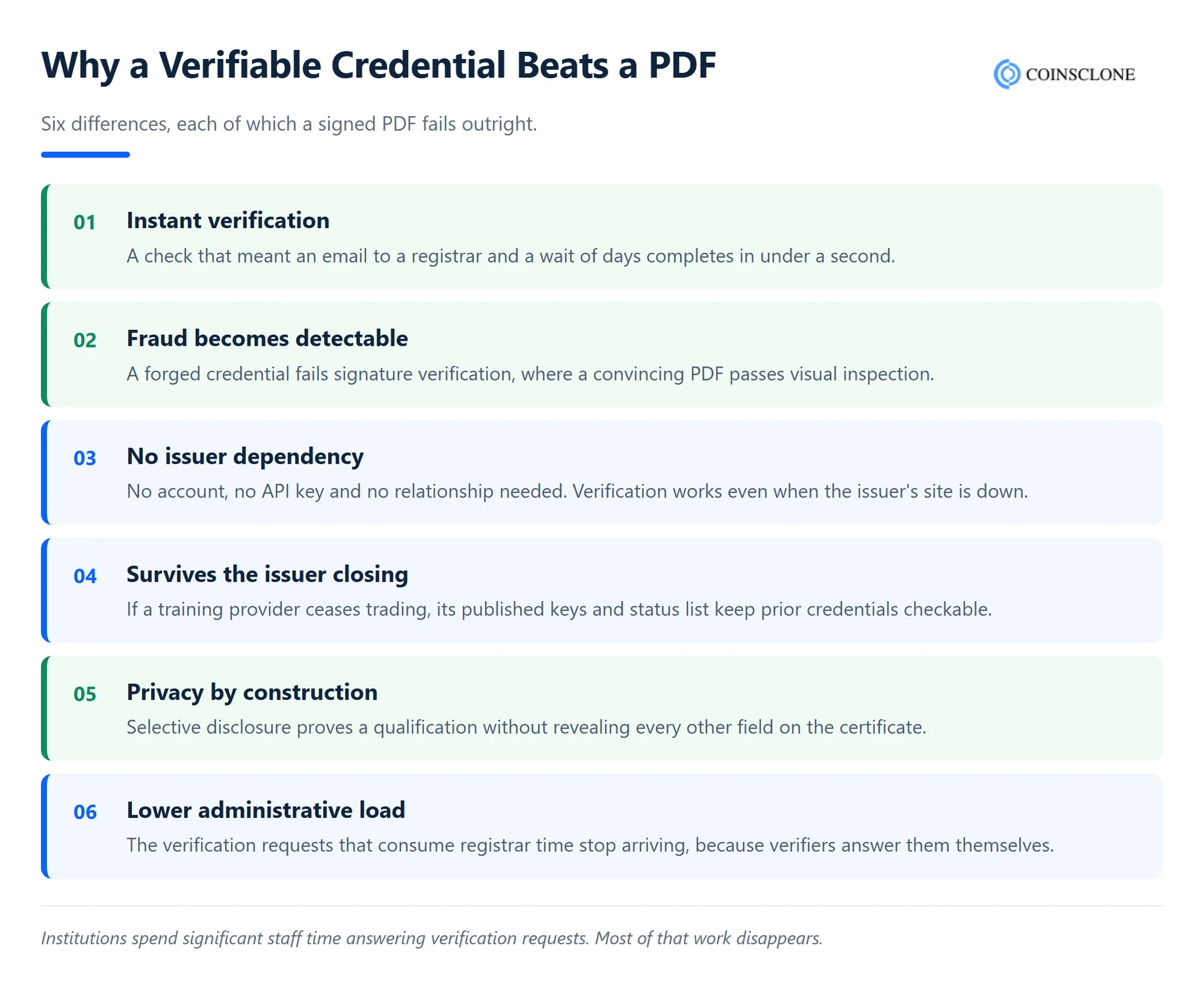
- Instant verification. A check that used to mean an email to a registrar and a wait of days completes in under a second.
- Fraud becomes detectable. A forged credential fails signature verification, where a convincing PDF passes visual inspection.
- No issuer dependency. A verifier does not need an account, an API key or a relationship with the issuing body, and verification still works if the issuer’s website is down.
- Works after the issuer closes. If a training provider ceases trading, its published keys and status list keep prior credentials checkable.
- Privacy by construction. Selective disclosure lets a holder prove a qualification without revealing every other field on the certificate.
- Lower administrative load. Institutions spend significant staff time answering verification requests, and this removes most of that work.
How Does Credential Revocation Work?
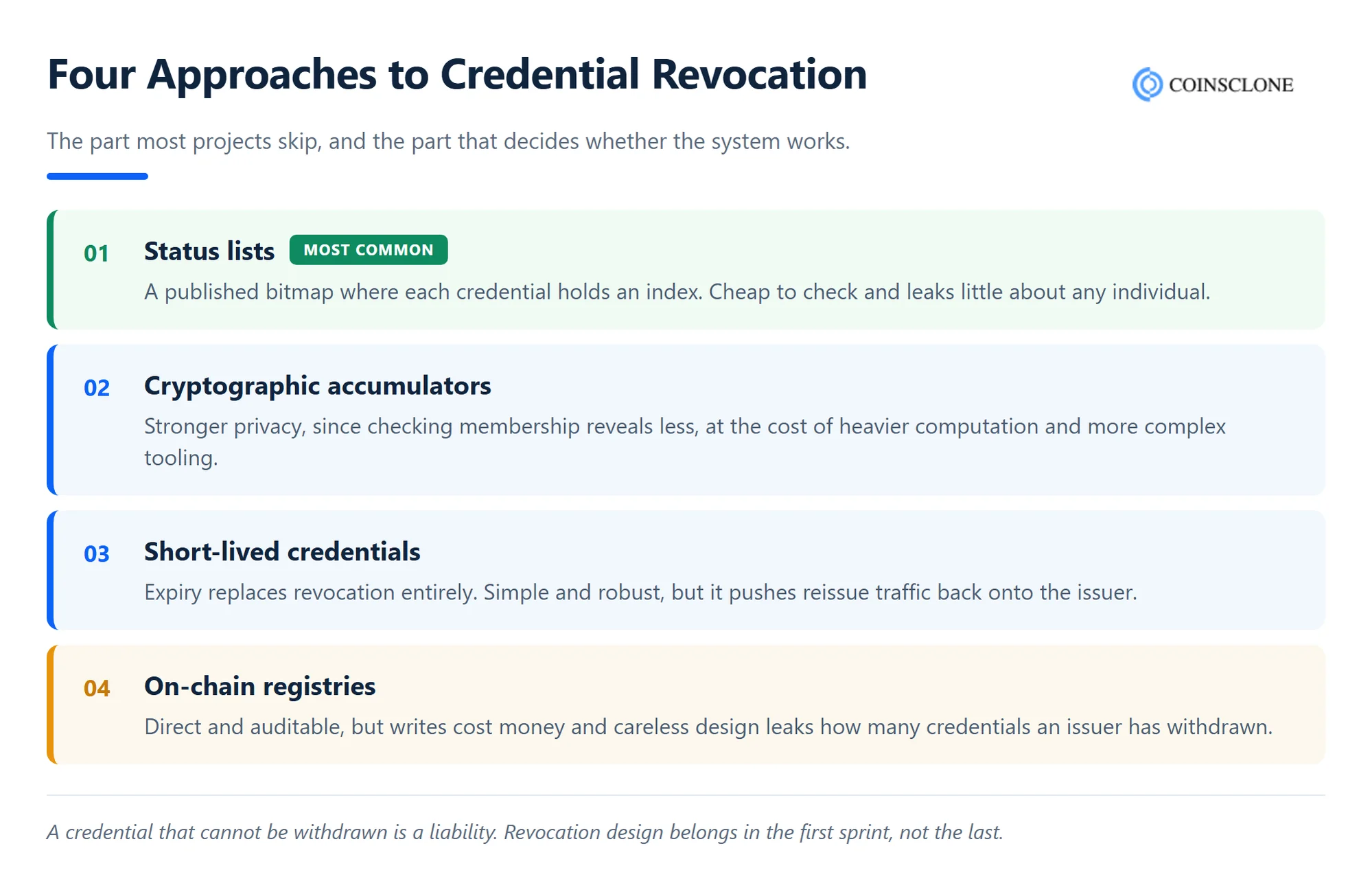
A credential system without working revocation is a signed PDF with extra steps, and this is the component most commonly underspecified.
Status lists publish a list a verifier checks. Simple and widely supported, though they can leak information about individuals if not designed carefully.
Cryptographic accumulators allow a holder to prove their credential is not revoked without revealing which credential is being checked, at the cost of greater complexity.
Short expiry avoids revocation entirely by issuing credentials that expire quickly and are frequently reissued, which shifts effort to the issuer.
Verifier discipline matters more than any of the above, because none of these mechanisms function if verifiers do not actually perform the check.
Ask any vendor how revocation is published and how a verifier checks it. Vague answers on this point are disqualifying.
Who Is Already Issuing Verifiable Certificates?
Academic qualifications, with degrees and transcripts issued directly to graduates who then hold them permanently.
Professional licenses, where reliable revocation genuinely matters because practising on a suspended license carries consequences.
Training and certification, particularly vendor and safety certifications that expire and renew on cycles.
Employment history, with verified roles and dates that reduce background check effort and cost.
Supply chain attestations, where audit and compliance certificates are presented to buyers who currently take them on trust.
Government credentials, including identity and entitlement documents now appearing in mainstream wallet ecosystems.
Adoption follows the verifier rather than the issuer. Issuing credentials that nobody accepts anywhere produces a pilot; issuing credentials people can actually use somewhere produces a program.
Where Are Blockchain Credentials Used in Practice?
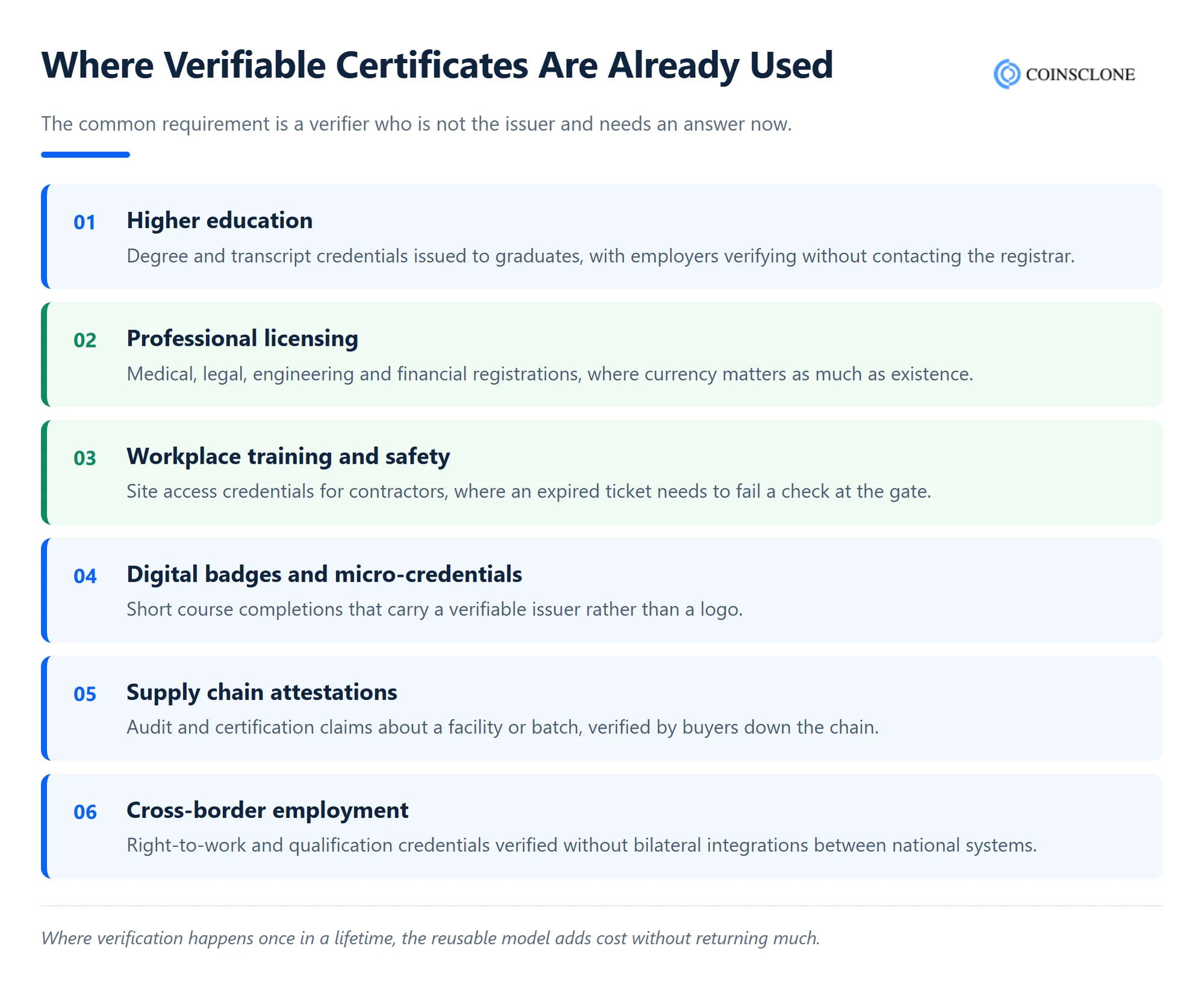
Verifiable certificates are furthest along wherever verification is frequent, fraud is costly, or both.
- Higher education. Degree and transcript credentials issued directly to graduates, with employers verifying without contacting the registrar.
- Professional licensing. Medical, legal, engineering and financial registrations, where currency of the license matters as much as its existence.
- Workplace training and safety. Site access credentials for contractors, where an expired ticket needs to fail a check at the gate.
- Digital badges and micro-credentials. Short course completions that carry a verifiable issuer rather than a logo.
- Supply chain attestations. Audit and certification claims about a facility or a batch, verified by buyers down the chain.
The common requirement is a verifier who is not the issuer and who needs an answer immediately.
Conclusion
Verifiable certificates solve a mundane and expensive problem: proving that a claim about a person is genuine, without a manual exchange between the verifier and the issuer. The model works because the credential travels with the holder and can be checked independently, which removes cost on both sides and gives the holder control over what is disclosed. Build it with revocation properly specified, keep personal data off the ledger, and start where a verifier is already waiting to accept what you issue.
Coinsclone builds enterprise-grade Web3 platforms including crypto exchanges, wallets, DEXs, NFT marketplaces, payment gateways and RWA tokenization, using customizable white-label clone scripts. Talk to our blockchain experts for a free consultation and live demo.
Frequently Asked Questions
What are blockchain credentials?
Digitally signed claims about a person, issued by an authority and held by the subject in a wallet they control. Any verifier can check the signature, revocation status and holder binding independently, without contacting the issuer. The credential itself is not stored on the ledger.
How are verifiable certificates better than PDFs?
They cannot be altered without invalidating the signature, they can be verified without contacting the issuer, verification still works if the issuer no longer exists, revocation can be checked instantly, individual attributes can be disclosed selectively, and the holder carries them across employers and countries.
Is the certificate stored on the blockchain?
No. The ledger holds issuer public keys, credential schemas and revocation status. The credential itself stays with the holder, because an append-only ledger cannot support correcting or erasing personal data and publishing credentials would create serious privacy problems.
How does credential revocation work?
Through status lists that verifiers check, cryptographic accumulators allowing proof of non-revocation without revealing which credential, or short expiry periods that avoid revocation by reissuing frequently. Whichever is used, it only functions if verifiers actually perform the check.
Who issues verifiable credentials?
Any authority whose assertion carries weight: universities, employers, professional bodies, regulators, training providers, auditors and government agencies. The value depends on whether verifiers recognize that issuer, which is a trust and accreditation question rather than a technical one.
What if the issuing institution closes?
Verification continues to work, because the verifier checks a signature against a published key rather than querying the issuer. This is a meaningful advantage for qualifications held across decades, where institutions merge, rebrand or cease to exist.
How do we start issuing credentials?
Begin where a verifier already wants to accept them, since adoption follows the verifier rather than the issuer. Define the credential schema, establish key management and revocation, choose a wallet approach for holders, and integrate issuance into the system that already records the underlying qualification.